
Many, many, many otherwise very nice aquatic plants have come to a gruesome end in the unforgiving conditions on the river run of the Shrimphaus. In fact, only two have managed to thrive. The first and most successful is the liverwort Riccardia chamedryfolia. The Riccardia does a beautiful job of colonising across the small loose slate chippings substrate on the river. The other success, perhaps aided by the moderating influence of the Riccardia, is Lysimachia nummularia ‘Aurea’, otherwise known as ‘Creeping Jenny’, which has also done reasonably well emersed.

Creeping Jenny is a marginal plant, so is used to being wet on the bottom and dry on the top. It can have a nice fresh green look emersed and the trailing lines of it can be flopped over things or folded over the top. The Jenny also does a pretty good job of not getting monstrously big, which is appreciated. Even though I first planted it 5 years ago, I have never seen it flower.
Recently I saw some very pretty looking emersed Bacopa caroliniana on display (can’t recall where). Apparently it can make some pretty blue flowers. That gave me the idea of trying it again on the river. There is certainly no shortage of supply – the Fireplace Aquarium grows Bacopa caroliniana the big-time (the green version – the purple salzmannii version just rots and dies) so there is lots of material to play with.
Transitioning submersed to emersed
Heh. This is running the usual problem backwards. The usual problem is you purchase an aquarium plant that has been grown emersed hydroponically, and then you submerse it and ask it to adapt to life fully underwater. In theory going from submersed to emersed should be easy, because mostly the submersed plants are desperately trying to get to the surface so they can directly access all that lovely atmospheric CO2. So one idea is just to plant something submersed that you know will grow tall enough to get to the surface and just let it sort it out from there.
Some problems with that:
- The plant actually has to grow strongly enough submersed to get to the surface in the first place. In the low-tech Shrimphaus that turns out to be pretty challenging.
- If it gets to the surface it needs to adapt to surface conditions (lethally low humidity mainly) or it just gets to the surface and dies.
- Assuming it can get to the surface and then adapt to emersed growth it would be nice if it could actually stand up into the air and not just flop around all over the surface.
In fact I did already try taking emersed form B. caroliniana and planting it on the river and it did indeed just die straightaway. Turns out the hydroponics nurseries keep their humidity around 100% whereas currently my indoor humidity is 54%. Deal-breaker. Who knew?
Try a natural transition
That all said, I’m pretty sure in the wild B. caroliniana can grow in not tropical rainforest type of climates, so the trick is to let it figure out what it needs to do for emersed growth without dying first.
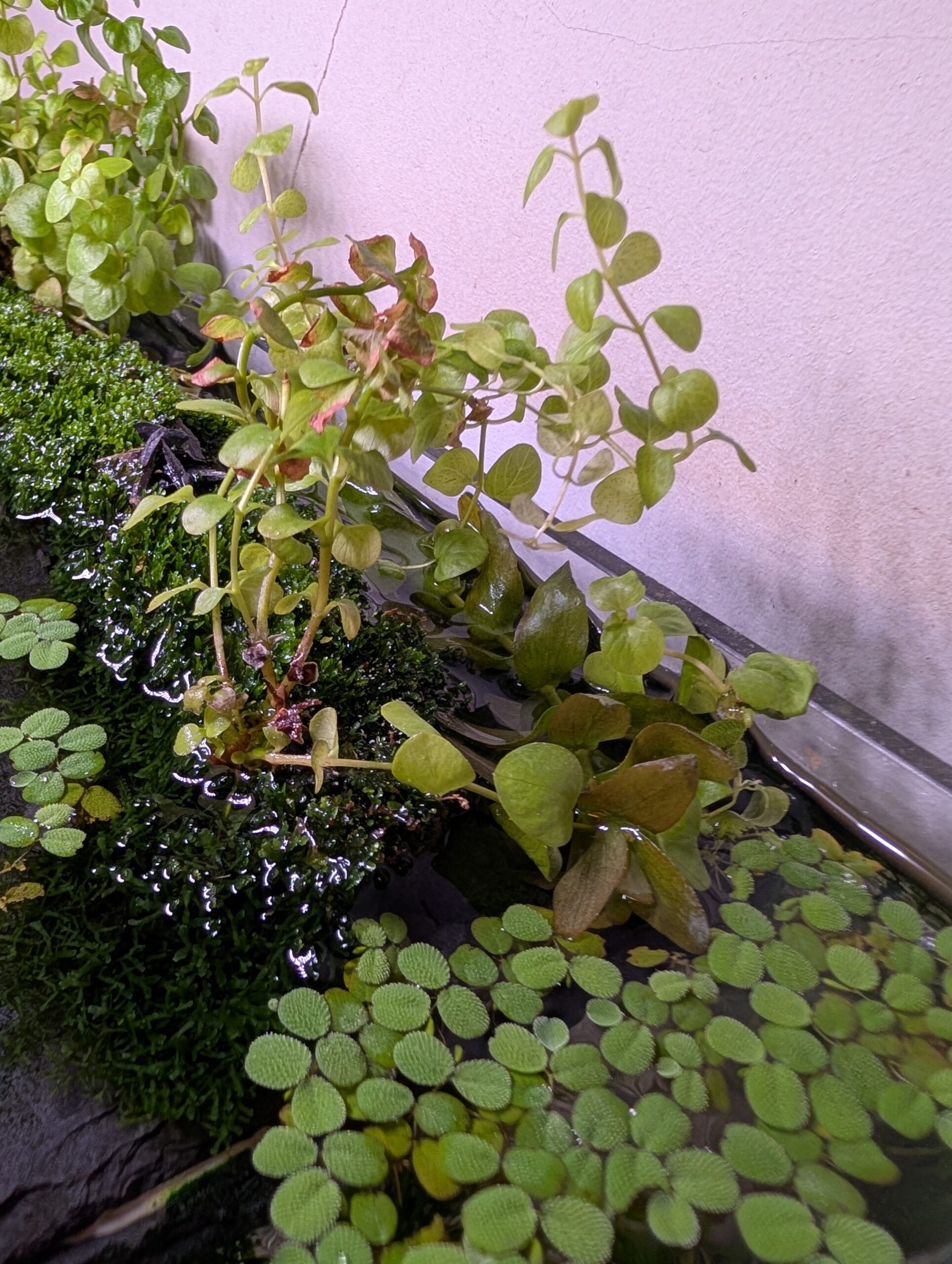
What I’m trying is to take a pretty good healthy cut submersed piece of the Bacopa and just laying it on the water surface of the Shrimphaus towards the back of the river. Bacopa doesn’t need roots to get going making new roots so having it be cut is not a problem. The idea is for it to be on the surface, but in as high a humidity micro-climate as possible, to give it time to sort out what it needs to do, including getting some roots established into the Riccardia lawn right next to it.
So we’ll see how that goes.