
Schismatoglottis prietoi, apparently increasingly known as ‘Philippine anubias‘, is a brilliant aquarium plant with an unpronounceable name so don’t let that put you off!
Schismatoglottis prietoi requires almost no maintenance
This what makes this plant so special. A lot of aquascaping plants go through a number of stages. You first get them and they are small and maybe need to transition to submersed growth from emersed growth. Then (hopefully!) they find their groove and start to grow into their new habitat. They mature up and start to look like all those amazing ‘glossy photographs’ (or more contemporaneously potentially-Photoshopped webpages) and everything is good. But then, they keep growing. Sometimes they start to get scaggy. Maybe they develop a lot of unsightly aerial roots. Maybe you have to keep trimming them and that gets to be a hassle. Maybe they build up a lot of dirt and debris and start to go wrong. Not Schismatoglottis. Gets nice, and stays nice!
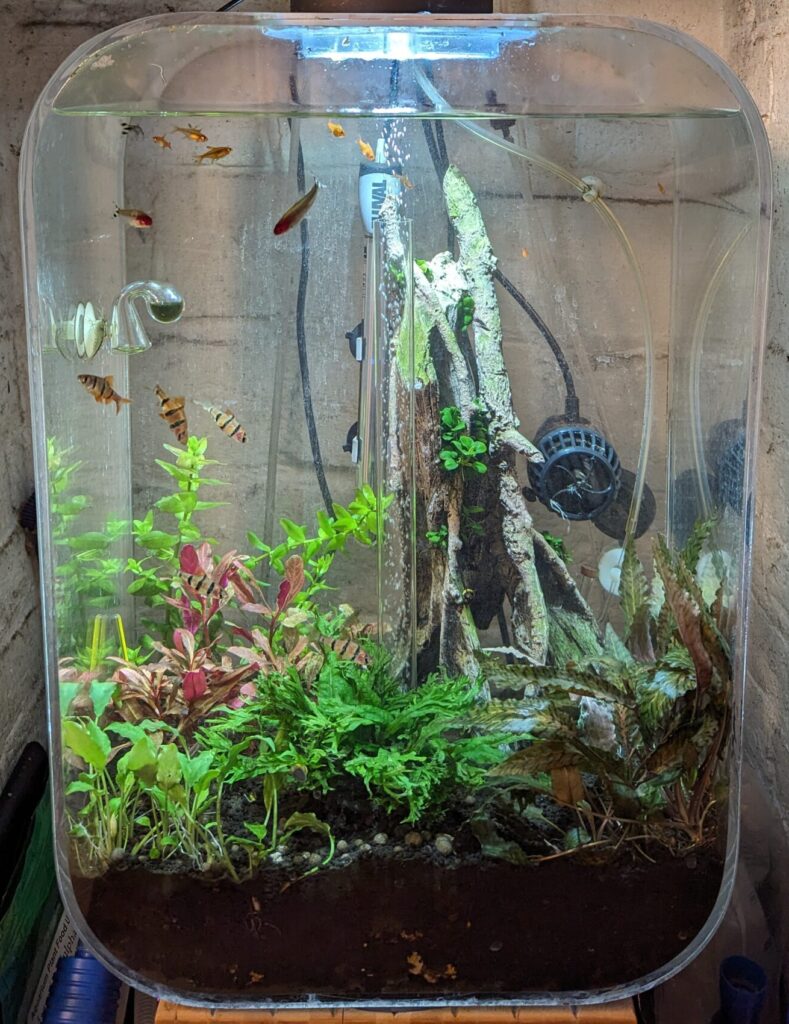
Just planted
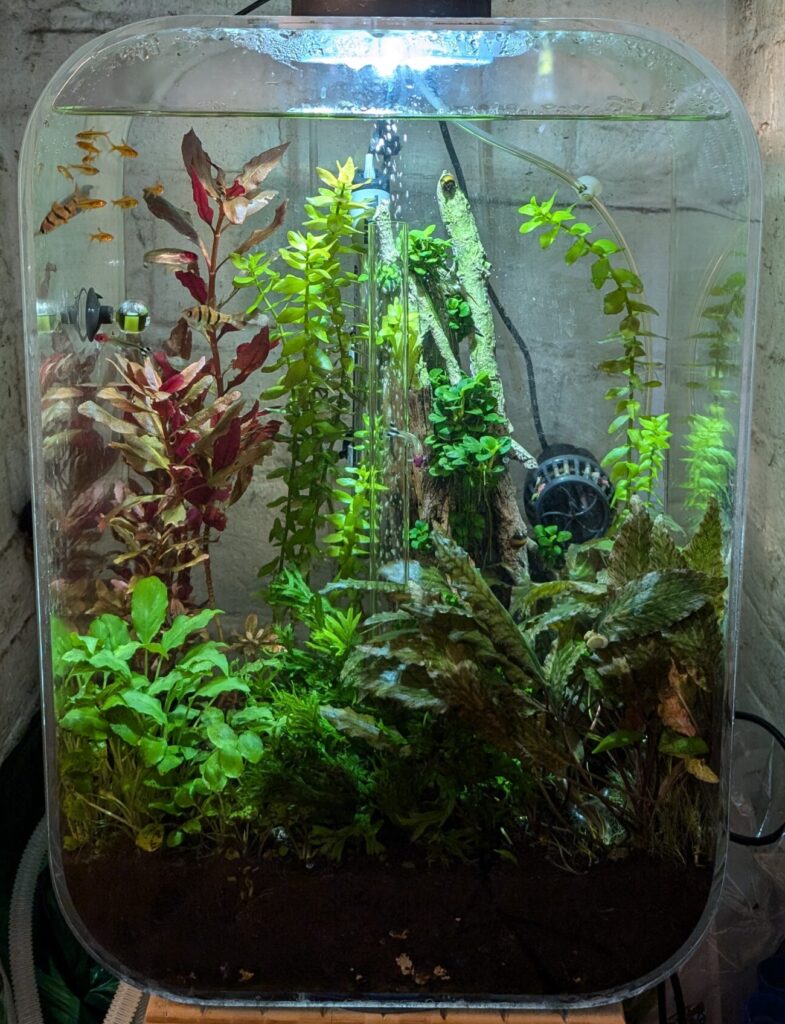
7 months
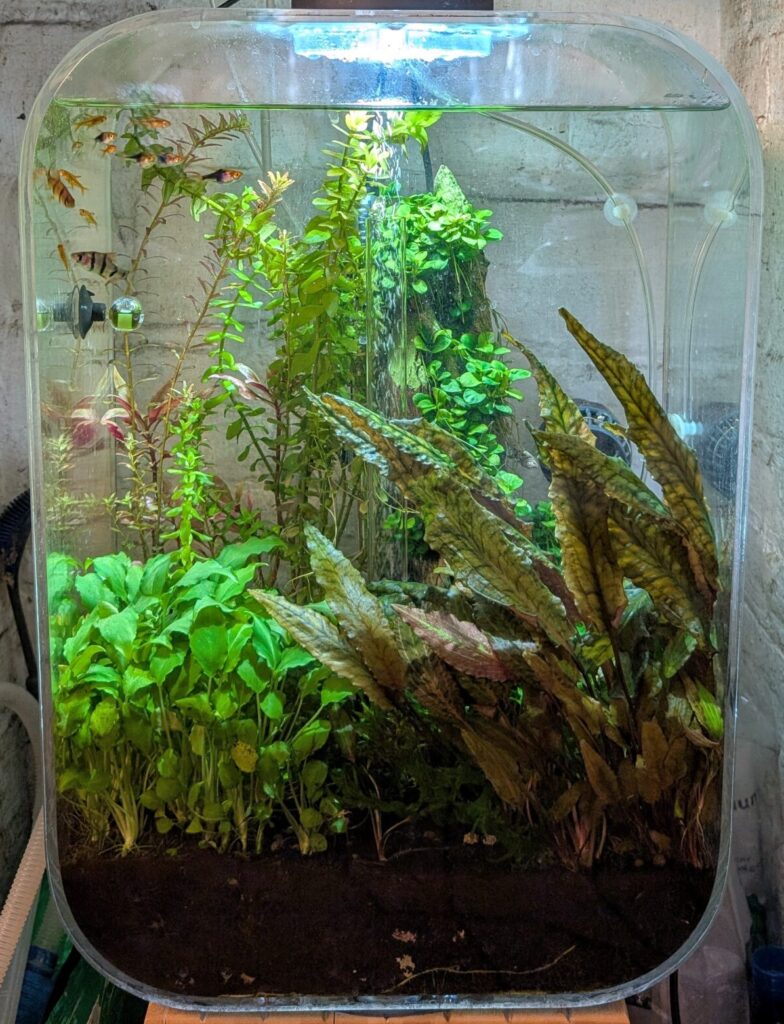
14 months

23 months
The photos show how this works. The Schismatoglottis is a pretty bright green colour and over the course of around 2 years grows into a nicely behaved, dense little patch of forest. Importantly and unusually, the shaded understory of the forest stays attractive looking with well behaved ‘stem trunks’ that don’t accumulate a lot of debris. Over the course of the two years I did no maintenance at all on the Schismatoglottis: no trimming, or thinning or replanting. The horizontal spread of the planted patch proceeds at a very measured pace. There is a slow yet steady build-out in place and no “escaping” to colonise the other side of the aquarium.
Replanting Schismatoglottis is straightforward
It was time for another large rescape in the Fireplace Aquarium. I really like the Schismatoglottis look so am reinstalling that. Taking out the large forest was straightforward to do and it all came out in a block without a lot of excess mess. The roots don’t actually go super deep so they don’t dig up a lot of debris coming out which I appreciated. As previously, temporarily installing a retrofitted (with more and finer filter pads) Eheim miniUP did a nice job of polishing the water. A few iterations with a turkey baster was all that was needed. After all was said and done the soil level did come down a bit – I didn’t replace the biOrb ceramic media that got pulled up – so I added two cups of fresh Tropica aquarium soil to make up the difference.
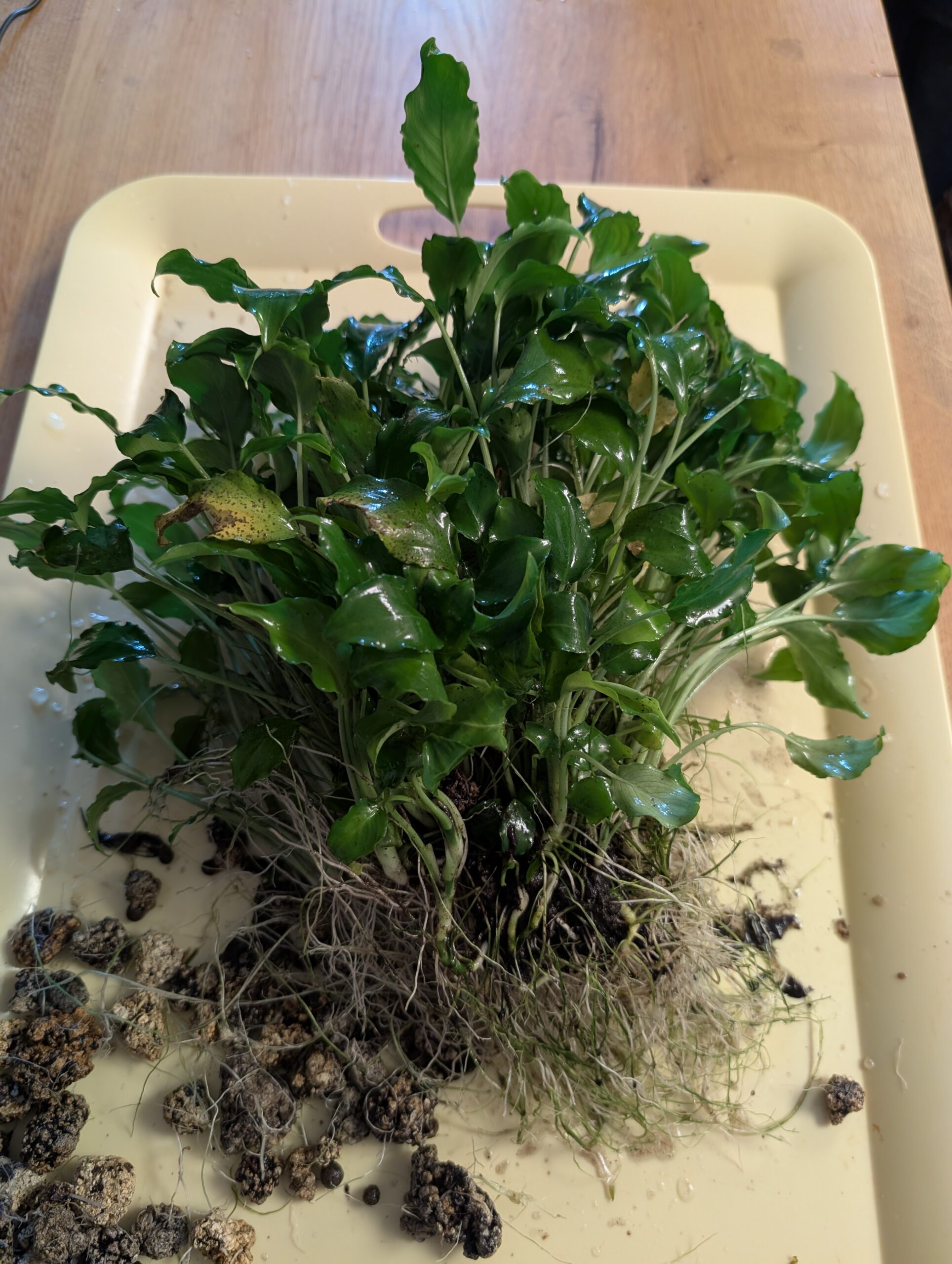
Schismatoglottis prietoi plant mass
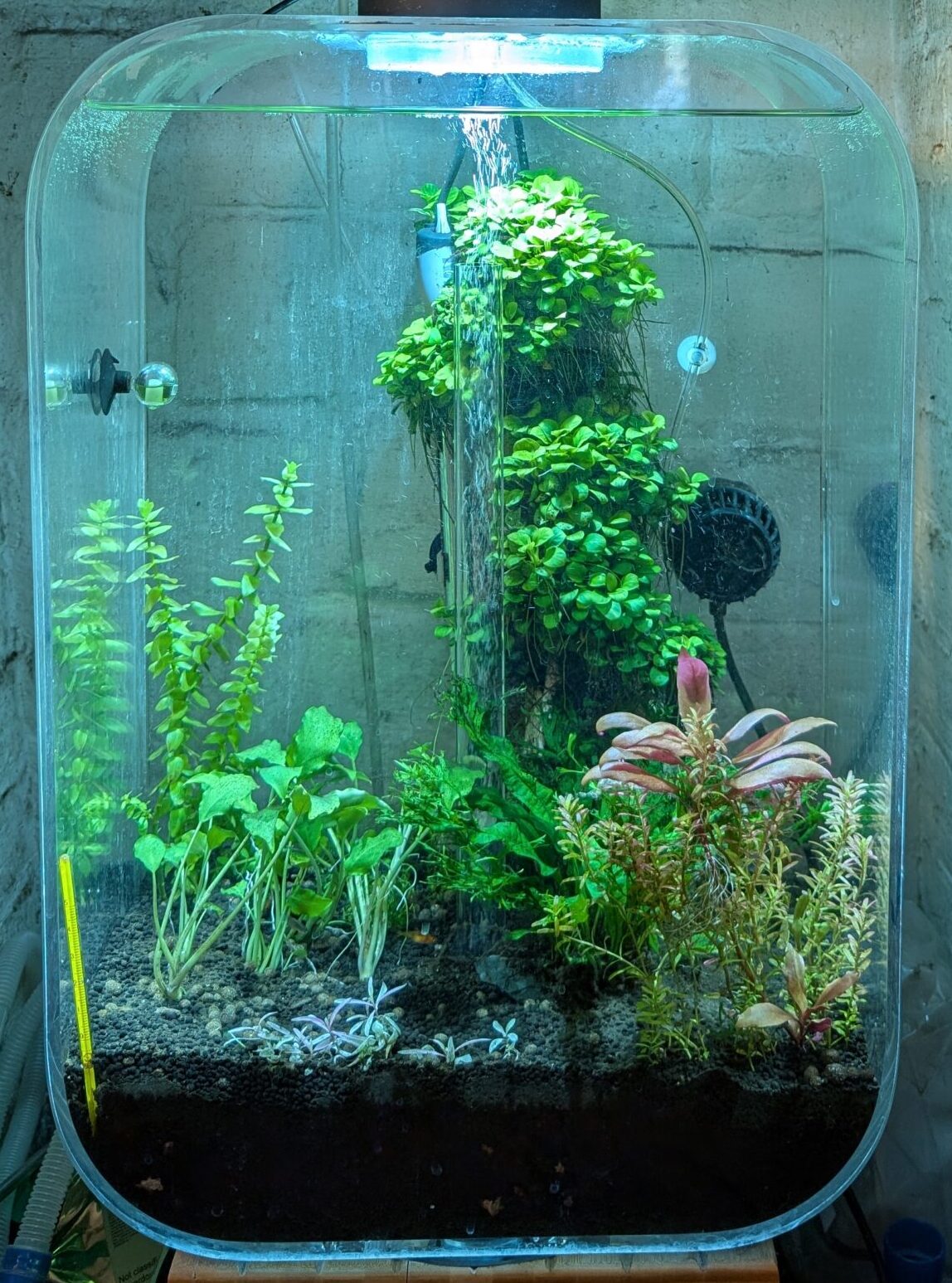
post-rescape
The plant mass is interesting. The different Schismatoglottis ‘trees’ are all interconnected by short thick runners (stolons) but were still easy to separate. I carefully took of 5 or 6 really nice pieces and replanted those back in the same location.
Schismatoglottis prietoi is a nice midground plant
With a maximum height of 20 cm the Schismatoglottis in my book counts as ‘midground’. Misleadingly, Tropica tells you the height of the plant is “3-8 cm” where this is the “average height (cm) of the plant after two months in the tank.” Dennerle is also on that page. That might be true, but unless you want to replant every two months you should accept (and plan) for the plant to get significantly larger than that. One might be tempted to think the vendors want you to put this plant into you scape only to discover 4-6 months later that it is much larger than you planned for and needs to be replaced with a different purchased plant… In my case, the newly replanted plants are already 10 – 12 cm tall.
Do you “bury the rhizome” or not? (in this case, yes!)
Confusingly, Dennerle also lists Schismatoglottis prietoi as an epiphyte, similar to Anubias, and says it can’t be planted in substrate but must be attached to wood or rock. I’m here to tell you that’s straight up wrong – this plant does brilliantly when planted in substrate. Going to the official citation “a new and remarkable aquatic species of Schismatoglottis (Araceae) from the Philippines” the plant is described as “colonial stoloniferous aquatic or amphibious herb 2-8(-17) cm tall.” Kew says of Schismatolgottis prietoi: “The native range of this species is Philippines. It is a perennial or rhizomatous geophyte and grows primarily in the wet tropical biome.” Turns out the plant has both a rhizome and stolons. The rhizome is the thickened vertical base-like structure you can see in the just-dug-them-up photo which are for nutrient storage – the ‘geophytic’ piece. The stolons which launch horizontally are for spreading and propagation. In this case, as for Cryptocoryne species which are similar, this is the type of downwards directed rhizome you DO want to bury in substrate, as opposed to the horizontally spreading rhizomes of e.g. Anubias or Bucephalandra species.
That all said, you can also attach Schismatoglottis prietoi to hardscape where it might behave like an Anubias, or alternatively, you could just get an Anubias for your hardscape such as…
Anubias barteri ‘Mini Coin’ is easy too
As a side observation, the Anubias barteri ‘Mini Coin’ got planted on the mountain at about the same time as the Schismatoglottis so the pictures show how that progresses as well. It is also reasonably well behaved. The only maintenance for the epiphyte is occasionally some of the longer roots get colonised with black beard algae and need to get trimmed off.