TL;DR: Problems with algae? Turn down lighting intensity
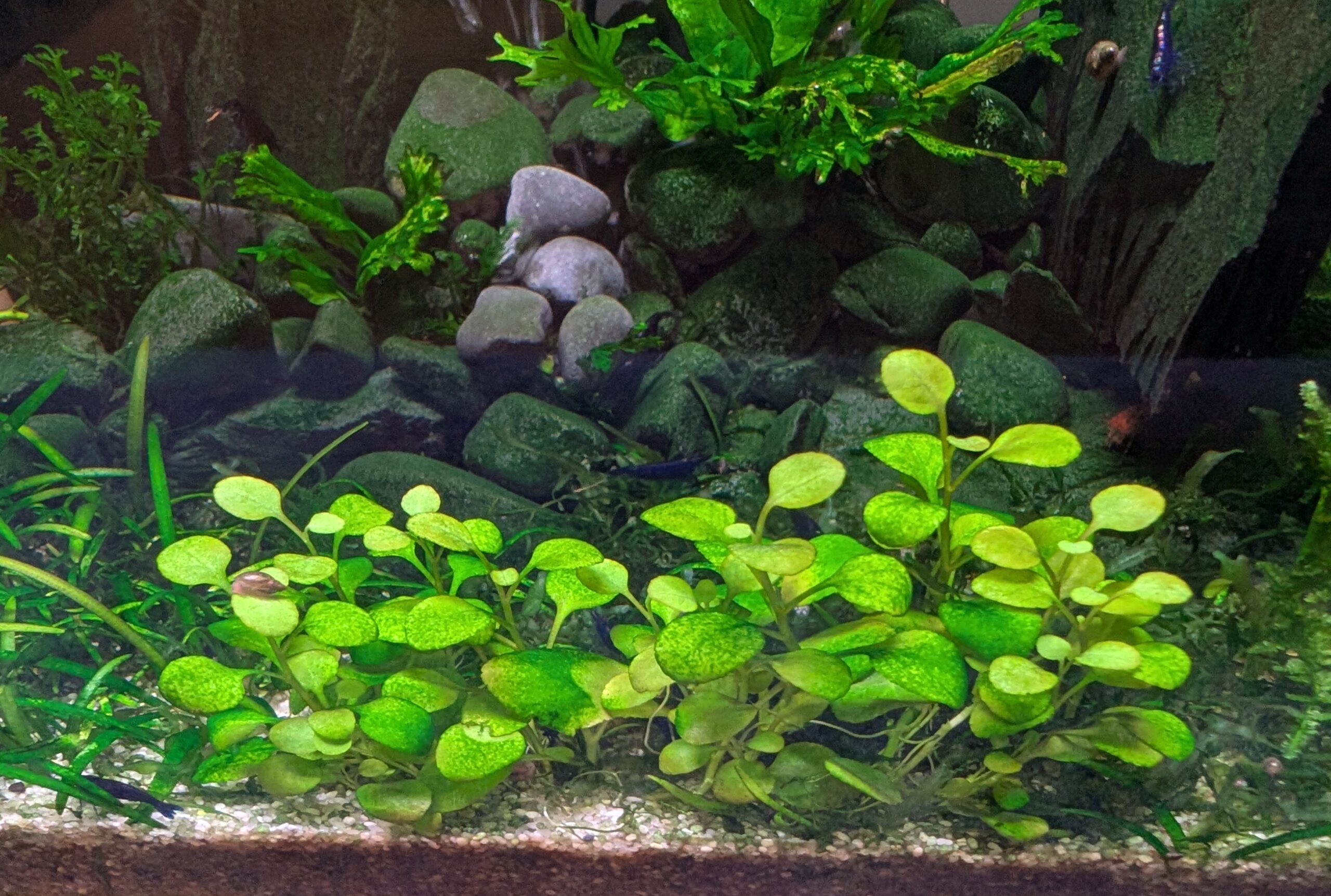
Sometimes there is wisdom online if you know where to find it and then actually listen to it. Clive at UKAPS for example advises against the “photon cannon” approach of blasting your aquarium with too much light. Too much light causes problematic algae. Lately I haven’t been very happy with algae in the Shrimphaus. The lit surfaces of the glass gets coated with a layer of what I thought were diatoms but now think is more of an algae-containing biofilm. More problematic however is green spot algae which colonises older plant leaves, in many cases very aggressively. One problem with nice LED lights like the Week Aqua series on the Shrimphaus is it can be very tempting to creep the intensity up over time. When first installed, I started the Week Aqua at 20% power, but now it’s set to 40% power. I think that’s the cause of these algae problems.
Intense light can damage underwater plants
That might not be a big surprise, but what counts as “intense” light is very context dependent. The problem turns out to be this guy…
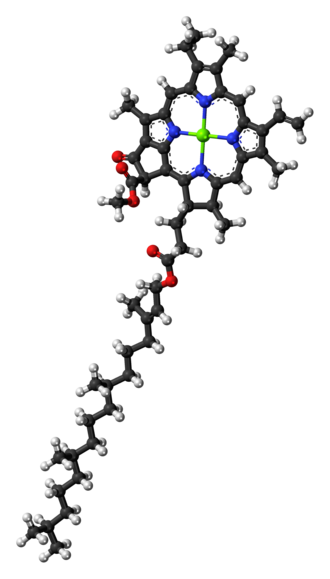
This is a ball and stick model of chlorophyll a, one of the most common of the various chlorophylls. Chlorophylls are quantum chemical machines. They absorb light, generally both red and blue wavelengths (not green, which instead gets reflected), and use the energy absorbed from the light to jump electrons up into a higher energy state. In the ordinary course of biology these high energy electrons are shunted off into a chloroplast-specific electron transport chain (ETC) which through a cascade of different reactions ultimately de-energises them and in the process produces ATP, one of the major molecular energy ‘batteries’ of cellular biochemical reactions.
The other half of the process is that since chlorophyll has sent electrons off down the ETC, chlorophyll needs to get some electrons back from somewhere to reset to its initial state. There is lots of water around so, with the help of a specialised protein-containing oxygen-evolving complex (OEC), the chlorophyll splits water apart (photolysis) to get some. The OEC is interesting for containing a reactive core of 4 manganese atoms, 5 oxygens and a calcium atom (Mn4CaO5) – if you were wondering why plants need some manganese this is why. Splitting water restores chlorophyll’s missing electrons and produces some H+ which also participates in both ATP generation and in converting NADP+ into NADPH (a cellular “battery” that stores reducing potential rather than energy). The leftover “waste byproduct” of the water splitting after you remove the electrons and the H+ is oxygen gas (O2) which maybe you can see on underwater plants as ‘pearling’ under the right conditions.
Chlorophyll does not have an off-switch
…and here’s the problem! The rate at which chlorophyll makes high-energy electrons using light is directly proportional to the intensity of the light hitting the chlorophyll. More intense light = more high-energy electrons. If you shine light on plants, this is what you get. The plant has no way to regulate how much of the light is converted to high-energy electrons: it’s an unstoppable photochemical machine. As the high-energy electrons pour into the ETC you get a build-up of both ATP and NADPH on the back end.
Happily, ATP and NADPH are exactly what is needed to convert CO2 into glucose, a very useful sugar molecule for the plant. This makes up a separate reaction called the Calvin cycle, or sometimes the “dark reactions”* since light is involved in the “other” reactions. Neatly, at the end of the Calvin cycle both the ATP and NADPH are converted back into their original starting materials: ADP and NADP+ respectively, so there is no net build up of either ATP or NADPH. Collectively, the light reactions coupled to the dark reactions is photosynthesis, the conversion of inorganic carbon in the form of CO2 into organic carbon (sugar), powered by light.
So that’s all good unless you don’t have enough CO2 – which can often be the case for low-tech tanks with strong lighting. If you don’t have enough CO2 available to the plant, the Calvin cycle can’t keep up with the light reactions and both ATP and NADPH do build up. When those build up, the electrons coming down the ETC don’t have anywhere to go, so the electrons get backed up in the ETC. When electrons get backed up in the ETC, the chlorophyll, which as we mentioned just can’t turn things off, keeps on pumping out high-energy electrons. When those high-energy electrons can’t go down the ETC, they go somewhere else instead. Unfortunately that somewhere else can be oxygen gas – conveniently in high local supply due to photolysis – which makes all kinds of really nasty “reactive oxygen species” (ROS). Things like hydrogen peroxide, and free-radical flavours of oxygen. Things that can really do a lot of damage to plant tissues.
Algae loves damaged plants
To make things even worse, algae grows really well on plant surfaces that are roughed up and damaged. The rough surfaces make for easy gripping for the algae and give the algae a great platform to enjoy all that excess light for themselves. As plant tissues get damaged they also leak organic compounds into the immediately adjacent water. These organic compounds are a nice additional food source for algae.
You want light intensity to be limiting, not CO2 availability
How to fix it? You need to make sure that the rate at which chlorophyll takes up intense light is not higher than the rate at which the Calvin cycle can grab CO2 to use up the products of the light reactions. The rate part is the key here. When controlling light you have two levers: how long the lights are on for (the photoperiod), and how intense the lighting is. The thing is, all of the reaction products of the light and dark reactions are not very stable – they won’t build up just because the lights have been left on for more time. Where they do build up harmfully is when the rate of production exceeds the rate of consumption and here the big levers are the intensity of the light, and the concentration of dissolved CO2 gas in the water. In a low-tech (not CO2-injected) tank assuming you have reasonably good water flow to keep everything well distributed, your only useful lever is light intensity. If you’re getting a lot of algae, particularly on older plant growth, fix it by turning down the light intensity.
Notes
* The “dark reactions” can happen just fine in either light or dark. They just don’t require light in the way the light reactions do.