| Parameter | Shrimphaus water just before water change | Ferts contribution / week |
|---|---|---|
| Conductivity µS/cm | 922 | 20 |
| KH °dKH | 1.41 | 0 |
| GH °dH | 19.077 | 0.153 |
| Ca mg/L | 127.4 | 0 |
| Mg mg/L | 5.38 | 0.664 |
| Ca:Mg | 22.55 | n/a |
| K mg/L | 6.89 | 3.33 |
| Na mg/L | 26.49 | — |
| Cl mg/L | 200.68 | — |
| SO₄ mg/L | 31.7 | 4.65 |
| Cu µg/L | 2.94 | 1.1 |
| Zn µg/L | 5.7 | 5.57 |
| Ni µg/L | 1.33 | — |
| Co µg/L | 0.06 | — |
| Cr µg/L | 0.09 | — |
| Fe µg/L | 28.34 | 39.36 |
| Mn µg/L | 0.06 | 8.74 |
| B µg/L | not detected | 5.04 |
| Mo µg/L | 1.9 | 0.72 |
| I µg/L | 7.48 | — |
| PO₄ mg/L | 2.9 | 0.921 |
| NO₃ mg/L | 52.29 | 2.06 |
| Nitrite mg/L | 0.006 | — |
| Si mg/L | 9.355 | — |
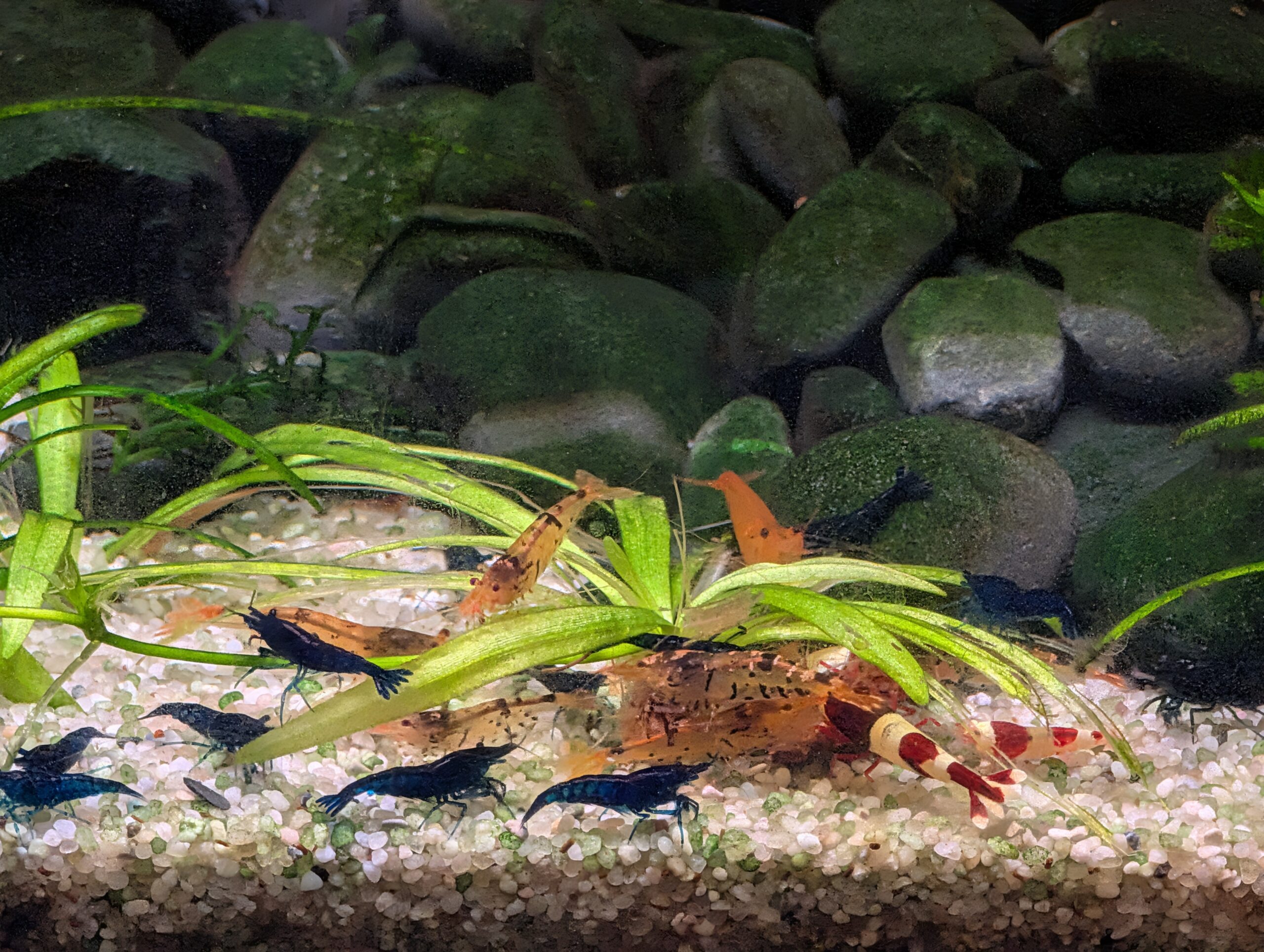
Shrimphaus has highly unorthodox water chemistry, yet successfully breeds both Caridina and Neocaridina freshwater shrimp. Modern water chemistry analysis shows what really matters and what might be hobby-lore myth. Let’s dig in.
Really important: low alkalinity and low copper
Low alkalinity: around 1 dKH / 20 ppm CaCO3 equivalents
Shrimphaus water is prepared by hydrochloric acid (HCl) neutralisation of the alkalinity in Cambridgeshire tap water. I aim for the water change water to be 10 ppm CaCO3 equivalents (~0.6 dKH) and for the in-tank water to be no more than 20 ppm CaCO3 equivalents (~1.2 dKH). Although Neocaridina shrimp can tolerate higher levels of alkalinity, this is much less true for Caridina species. In higher alkalinity water Caridina will not only not thrive, the population will (in my experience) be gradually lost over the course of a few months.
With Shrimphaus running at 22C in a typical indoor environment the pH at this level of alkalinity is around 7.5.
The mechanism of alkalinity-mediated physiological stress to shrimp is not entirely clear, but there is a direct link between water alkalinity and pH that likely plays a role. Higher pH shifts the equilibrium between non-toxic ammonium and toxic ammonia towards the ammonia side. There may not appear to be any directly observable acutely toxic effects but the cumulative chronic toxicological effects seem very real.
Low copper: under 3 ppb
Although copper is an essential element for their physiology, shrimp are super-sensitive to copper and generally get what they need from their food. Plants also need copper, but not very much – 1 ppb (µg/L) will generally suffice, and as Estimative Index micro nutrients can supply considerably more than that, you need to be careful – Shrimphaus runs with reduced levels of EI micro nutrients and still gets 1 ppb copper from the fertiliser. My household plumbing done in copper leaches in a minimum of 5 ppb even after I flush the pipes vigorously before collecting water. Again, there are species differences with Neocaridina less sensitive than Caridina.
Copper toxicity can be estimated using the biotic ligand model and it was these calculations that made me first suspect low level chronic copper toxicity in the early Shrimphaus. For successful breeding, particularly for Caridina, if starting from tap water you’ll need to make the water copper-safe for your shrimp. In the Shrimphaus, breeding didn’t successfully happen with the Caridina with EDTA-chelated copper at levels of 5 ppb. In other words, at least so far as making water copper-safe for shrimp is concerned, water conditioner isn’t really fully up to the job. After reducing copper to 3 ppb the breeding is on!
Lots of things the hobby thinks are important… that just turn out not to be
High TDS is not necessarily bad – Shrimphaus TDS is 460+
Lots of hobby lore around shrimp needing low total dissolved solids (TDS). First, no one actually measures TDS – the ‘TDS pens’ you can buy measure electrical conductivity (in µS/cm) which is then converted into a TDS approximation by applying a ‘typical water chemistry fudge factor’, usually a 2x reduction. Shrimphaus operates at a conductivity of 922 µS/cm, which works out to a ‘TDS’ reading of 461.
Why this myth that shrimp need low TDS? I think because ‘TDS’ is easy to measure and when TDS is high it usually (but not always) means alkalinity is high so people got used to the idea that high TDS is bad.
High dGH is fine – Shrimphaus has 19 dGH
This one is a little strange. There is this idea that ‘high dGH causes moulting failure’, specifically the “white ring of death” where a shrimp has not been able to successfully cast off a moult and gets constricted to death by it. Not sure what to say about this other than I have run Shrimphaus at ‘crazy high’ dGH for years and I’ve never seen any evidence of this. I think there are reasons why moulting can fail, but high dGH isn’t one of them. Note that Shrimphaus is a bit of a unique case with low dKH and high dGH – ordinarily these move together because a typical source of dGH is dissolved carbonate minerals which causes both high dGH (from calcium and magnesium) and high dKH (from the carbonates). I suspect that because high dGH often co-varies with high dKH, high dGH gets blamed for what is actually high dKH’s fault, sort of similar to what happens with ‘high TDS’.
There is also an idea that low dGH is also bad, and shrimp exoskeleton definitely requires calcium (the usual source of dGH) so that makes sense. I don’t know how low is too low and I’ve never tested it.
Ca:Mg ratio doesn’t need a special value – Shrimphaus is 22:1
Lots of people (e.g. Salty Shrimp remineralisers) suggest a good calcium level at what works out to be in the 20-40 mg/L range, with magnesium around 5 mg/L, where if you were to calculate a ratio you’d get 4:1 or so. But just because you can calculate a ratio doesn’t mean it actually matters. Shrimphaus has Mg at 5 mg/L (mostly because that’s what comes in through the taps) but has calcium much higher, around 125 mg/L, giving what would seem to be a sky-high Ca:Mg ratio.
However, considering a ratio of minerals like this as a target doesn’t actually make obvious sense. There is going to be a required minimum level of calcium for good health, and also a minimum level of magnesium for good health to be sure, but in general there isn’t much hard evidence that the water-column ratio matters, nor indeed is the water column the only source of Ca and Mg for the shrimp – biofilm grazing is another route. In any event neither the shrimp nor the plants in the Shrimphaus appear to suffer from low magnesium which would seem to refute the idea that you need to aim for some ‘special ratio’ like 3:1 or 4:1. As with TDS, the fact that something can be measured does not mean the measurement is physiologically meaningful.
High nitrate is not incompatible with successful breeding – Shrimphaus runs 30-50 ppm
Cambridgeshire tap water itself brings in between 25 to 30 ppm nitrate. Shrimphaus winds up well over that level, 50+ ppm at the last analysis. Doesn’t seem to be a problem for activity or breeding. I’m not sure where the idea that ‘high nitrate is bad’ came from. Most hobby-grade nitrate tests have terrible accuracy so mostly people don’t really have any idea what their nitrate levels are, even when they try to measure with a kit. What would be really bad would be nitrite, but Shrimphaus levels are super-low.
Big water changes are fine – Shrimphaus has a 90% weekly water change
You sometimes hear shrimp can’t tolerate big water changes, but I think the reality may be that shrimp don’t enjoy big changes in water chemistry (or maybe also water temperature). In the case of Shrimphaus, I do weekly 90% water changes but the water going in is a very good match for the existing water. The good thing about big water changes is it stops levels of everything, dissolved organic compounds, unused fertilisers, whatever, from building up. After I do a water change the shrimp seem extra energised for a day or so, but no evidence of distress or panic.
You can’t breed Caridina and Neocaridina in the same water… except obviously you can
Actually, you can find lots of examples of people who do this successfully so Shrimphaus is not unique in this regard even if the Shrimphaus chemistry is pretty unique. Rather I think what is going on is water optimised for Caridina is not very Neocaridina friendly – the pH is too low. Similarly water “optimised” for Neocaridina isn’t particularly Caridina friendly. So the typical recipes don’t work very well but it’s still very doable if you are a little (or even a really huge amount) different from usual.
Why Shrimphaus water is so unusual
Mixed shrimp populations having a go at a Shrimp Cove protein bar
You almost never see a situation where water is low dKH and high dGH at the same time. Shrimphaus gets there because it starts with high dKH and high dGH that come with Cambridgeshire tap water and I add HCl to reduce the alkalinity. The HCl effectively exchanges bicarbonate for chloride, so dKH is reduced and chloride is increased, and dGH remains unchanged. Look at the high chloride levels of the Shrimphaus: 200 ppm (mg/L). About 180 ppm of that comes from the added HCl and the remaining 20 ppm from tap water. Apparently the shrimp don’t mind this level of chloride either.
Use of RODI water
Lots of people use remineralised reverse osmosis / deionised (RODI) water. RODI resets both dGH and dKH to zero and removes essentially all dissolved ions. I think this does two really good things, one of which is widely acknowledged and the other you never hear of.
- RODI removes alkalinity. And this for sure is important and is really well known. Usually with Neocaridina (but not for Caridina) people add a little alkalinity back just to provide some acid buffering capacity. I’m no different – I could take alkalinity down to zero, but I like to leave it between 10 to 20 ppm.
- RODI removes copper. This is the critically important piece that never gets discussed. Easy to overlook to be sure, but a few calculations using the biotic ligand toxicology model will illustrate how really pivotal copper removal is. If you don’t remove copper using RODI, you’ll need to remove it some other way, for example, by treating water change water with CupriSorb resin before adding water conditioner.
Because with RODI water some remineralisation is needed, a lot of myths arise around things like ‘high TDS’ – RODI is low TDS and you wouldn’t deliberately add TDS but that doesn’t mean it’s bad. Same with high dGH – there isn’t a reason to add high levels of dGH back to RODI water, but that doesn’t mean high dGH is bad either. You could remineralise RODI to give a high Ca:Mg ratio, but again why would you? Actually, high calcium can be protective for shrimp by out-competing toxic trace metals at the gill surface, so it turns out you might actually want to add high calcium, but it just isn’t really ever done.
I think much of the confusion in the hobby comes from mistaking the properties of typically remineralised RODI water that work well for a complete list of the properties shrimp actually require. RODI solves two important problems – alkalinity and copper – but that doesn’t mean the resulting low TDS, low dGH or conventional Ca:Mg ratios resulting from standard remineralisation recipes are themselves actual requirements.
Many paths to success
More broadly, there isn’t just one way to have a successful freshwater shrimp colony. It is tempting to try to recreate the natural conditions under which the shrimp are found, but even there, there is no guarantee that the conditions of today are the same as those to which the shrimp are best adapted. More to the point, there seems to be some under-appreciated resilience to freshwater shrimp – other than (in the Shrimphaus experience) requiring low alkalinity and low copper there seems to be considerable permissible latitude in shrimp husbandry. Successful tanks can share particular water chemistry parameters, but that does not mean every one of those parameters is required for success.