
It perhaps will not come as a big surprise that the hobby sometimes ascribes common names incorrectly to species names. Tangerine Tiger shrimp are a case in point. Tangerine Tiger shrimp are almost universally described in the hobby as Caridina serrata, but actually they are Caridina cantonensis (much more on that below). Does it matter whether Tangerine Tigers are C. serrata vs. C. cantonensis? Actually yes it does if you want to breed (or not breed) hybrids between Tangerine Tigers and other popular Caridina types like Bee Shrimp, Crystal Reds, Blue Bolts, Pure Red Line (PRL) and/or Tiger Shrimp (not to be confused with Tangerine Tiger Shrimp). If Tangerine Tigers really are C. serrata they would be too far removed genetically to make productive crosses, but if Tangerine Tigers are C. cantonensis, it’s game on!
TL;DR main Caridina species
For the Caridina freshwater shrimp species found in the aquarium trade, in the general case and excluding hybrids:
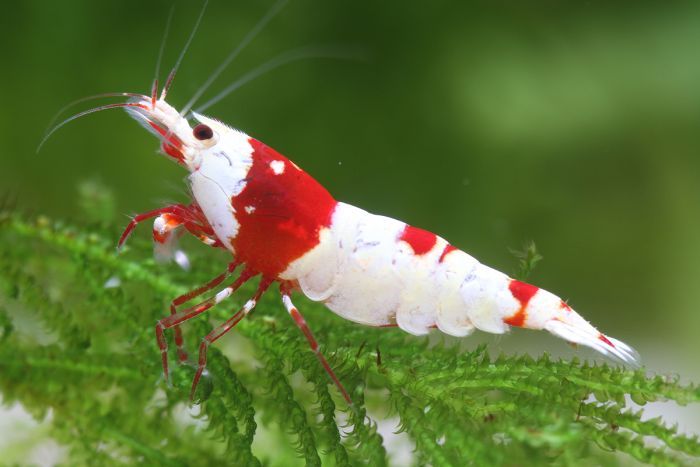
- Shrimp with solid bands of block-like colour are Caridina logemanni
- C. logemanni colour morphs: Crystal Red, Pure Red Line, Black Crystal, Wine Red Tiger, Pure Black Line etc.
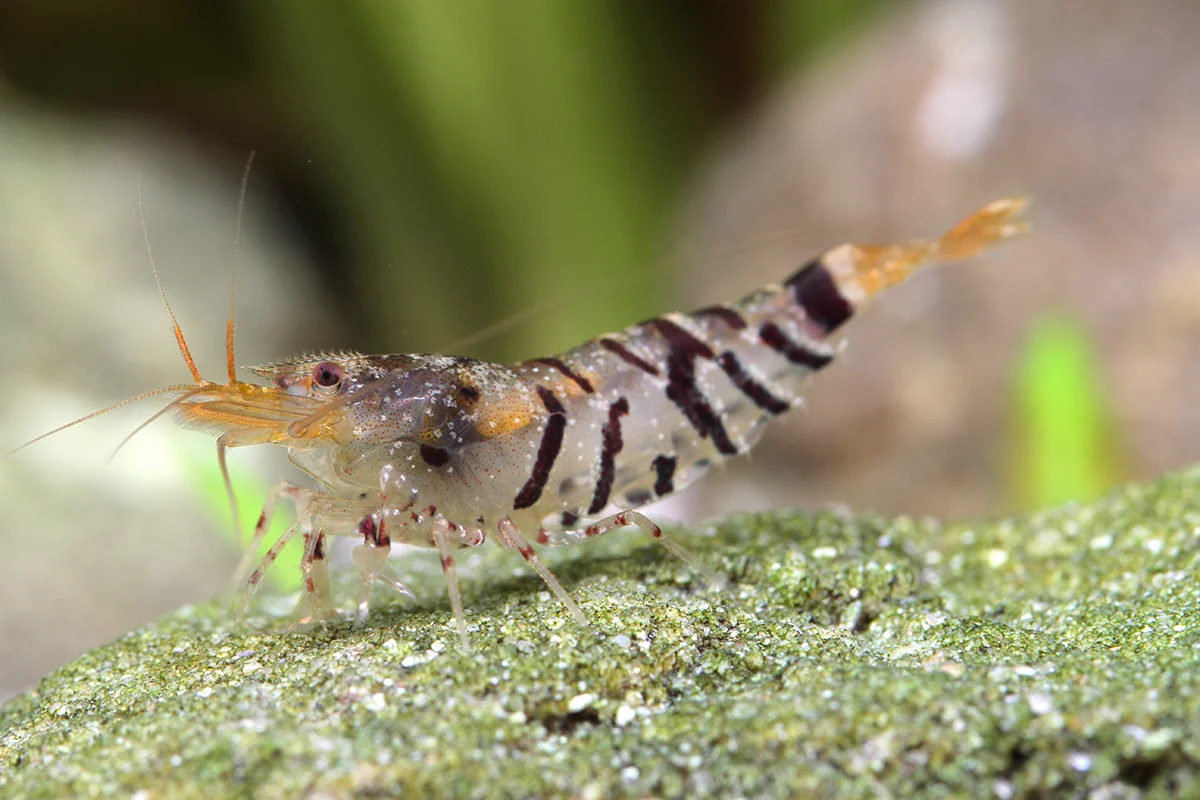
- Shrimp with repeating very distinct vertical stripes are Caridina mariae
- C. mariae colour morphs: Tiger, Blue Tiger, Red Tiger, Blonde Tiger
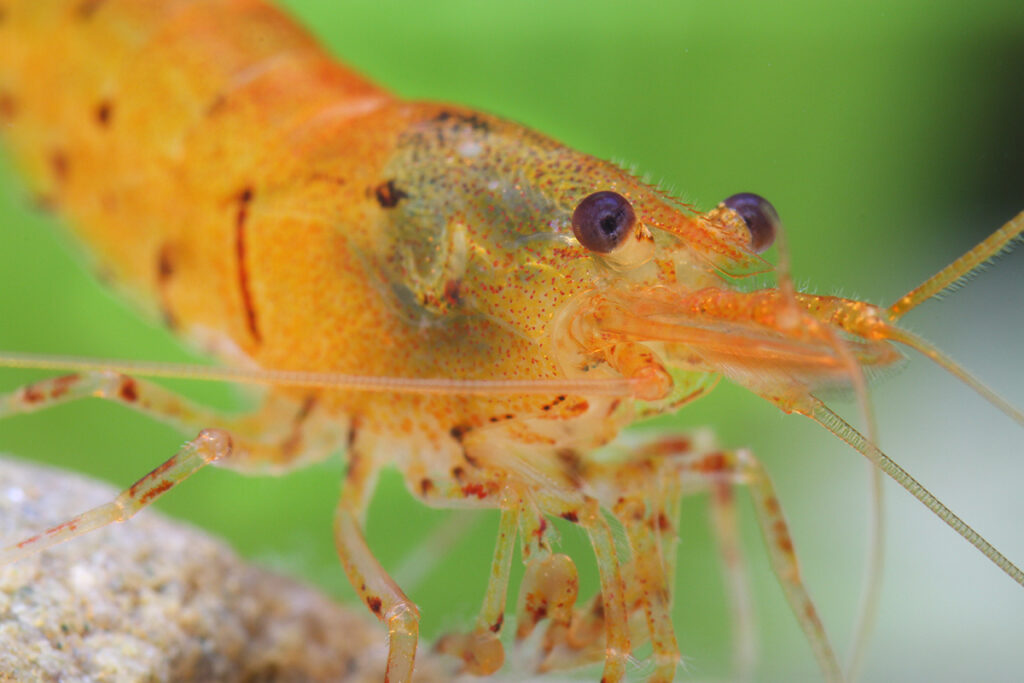
- Shrimp that are translucent or translucent with small spots are Caridina cantonenesis
- C. cantonensis colour morphs: Tangerine Tiger, Aura Blue, Blood Shot
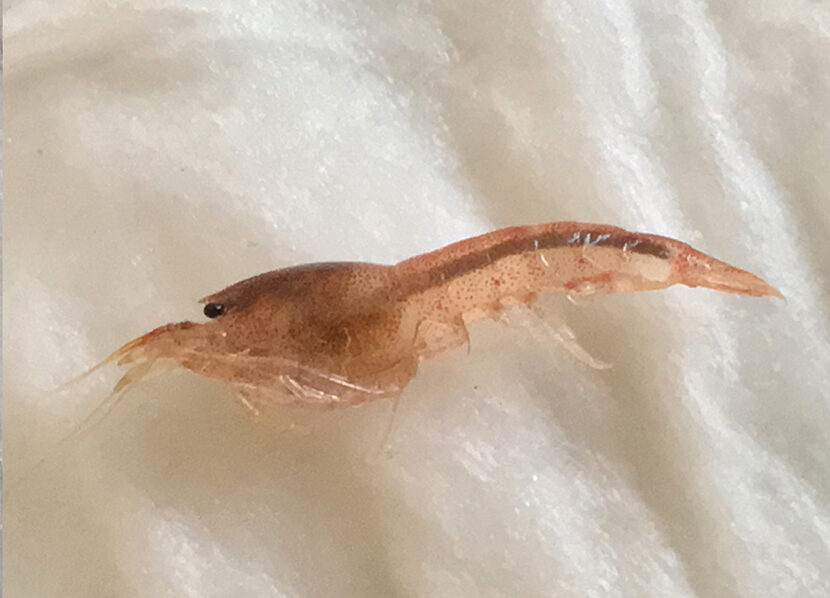
- Caridina serrata are not found in the hobby!
Tangerine Tiger: C. serrata or C. cantonensis?

Wild-type Caridina serrata
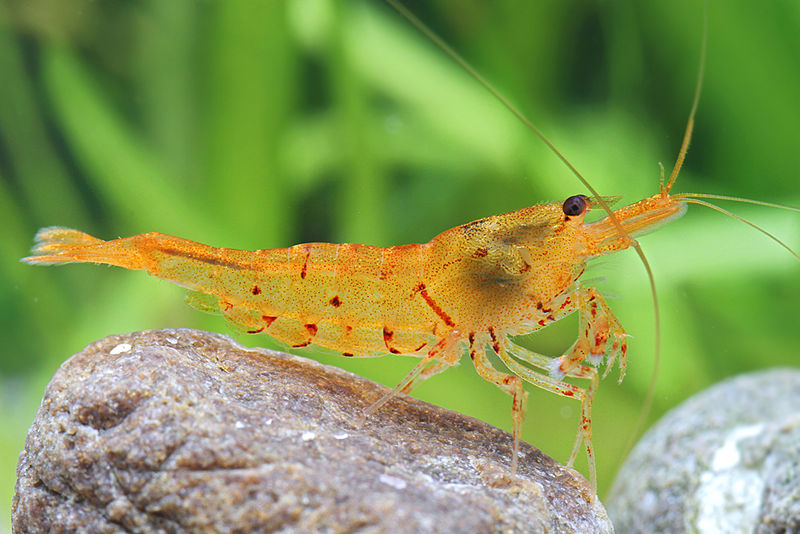
Tangerine Tiger – Caridina cantonensis
Ask the experts to sort a shrimp
Two seminal papers in the primary peer-reviewed literature address the topic:
- Hou, J., Zhang, J., Chen, B., Zhang, Y., Chen, W., & Guo, Z. (2025). Integrative taxonomy reveals the Caridina clinata Cai, Nguyen & Ng, 1999 species complex (Crustacea, Decapoda, Atyidae), with descriptions of eight new species from Hainan Island, China. Zoosystematics and Evolution, 101(4), 2295-2336. https://doi.org/10.3897/zse.101.172207
- Klotz, W., & von Rintelen, T. (2014). To “bee” or not to be—on some ornamental shrimp from Guangdong Province, Southern China and Hong Kong SAR, with descriptions of three new species. Zootaxa, 3889(2), 151-184. https://doi.org/10.11646/zootaxa.3889.2.1
I independently consulted Drs. Guo and Klotz and both kindly gave permission to quote their responses to this question:
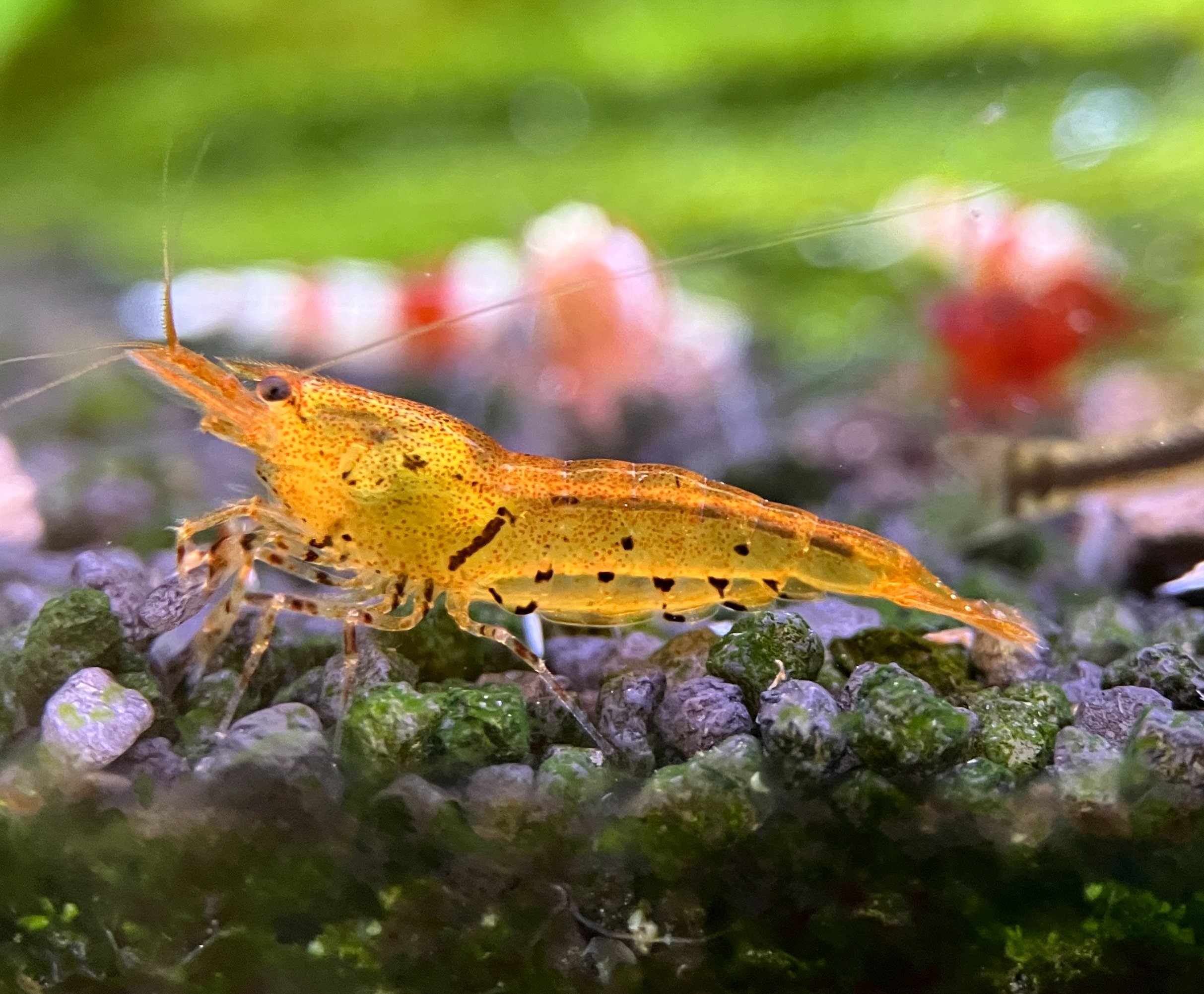
Tangerine Tiger (TT) parent
My question relates to the species categorisation of the Tangerine Tiger parent in the cross. In the hobby Tangerine Tiger shrimp are very commonly attributed to be Caridina serrata, but C. serrata is only distantly related to C. cantonensis genetically and I suspect such cross-breeding will not be productive. My suspicion is that the Tangerine Tigers have been mis-identified by hobbyists and commercial breeders as C. serrata when actually they are C. mariae, which is much closer genetically to C. cantonensis.
Do you have thoughts on whether these ‘Tangerine Tiger’ shrimp (picture enclosed) have been misidentified as C. serrata or whether a C. serrata x C. cantonensis hybrid really would be viable?
Werner Klotz
Tangerine Tiger shrimp were identified as Caridina cantonensis both with morphological examination as well as with 16s analysis by us. The Crystal Red Shrimp are Caridina logemanni, this species is very closely related to C. cantonesis thus crossbreeding is possible and done for many ornamental shrimp variants.
Zhaoliang Guo
Based on the photo you provided, this “Tangerine Tiger shrimp” belongs to a population distributed in the Zhuhai region of Guangdong Province. According to our current research findings, it is actually a variant of Caridina cantonensis. In sympatric environments, we have also identified the presence of Caridina serrata, but there is reproductive isolation between the two species, and they cannot hybridize.
This “Tangerine Tiger shrimp” can hybridize with Caridina cantonensis. Among their offspring, some individuals exhibit orange coloration—though usually lighter in hue—while others do not display any coloration. Theoretically, it might also be able to hybridize with Caridina mariae, but we have not yet conducted experimental verification.
Ok, so we definitely know that Tangerine Tiger shrimp are Caridina Cantonensis, and they are specifically not Caridina serrata.
That led to this follow-up question, again to both experts:
Does this brief summary below look correct to you?
- C. logemanni: Crystal Red Shrimp
- C. mariae: Tiger shrimp
- C. cantonensis: Tangerine Tiger shrimp (the picture I sent you)
Is there a species you’d assign to what the trade calls ‘Bee shrimp’, or are those also predominantly C. logemanni?
Werner Klotz
Yes, is correct.
„Bee shrimp“ does not really is restricted to one species but is an „umbrella“ for Caridina-like Shrimp with black/white or brown/white banded coloration. Some of these belong to the Caridina serrata species group (including C. logemanni), many to a larger, genetically related group of species including Paracaridina zijinica, C. tumida, C. huananensis, C. haivanensis or also not closely related species like Caridina boehmei from Sulawesi or Caridina zebra from Australia.
Zhaoliang Guo
Based on the information available to me, C. mariae indeed exhibits typical tiger stripe patterns. As for C. logemanni, it is known to be distributed in Hong Kong, but I have not yet obtained specimens of this species, so I am unaware of its specific pattern. The C. cantonensis in the photo you provided appears to be a color variant—commonly observed individuals of this species are typically colorless and translucent, rather than displaying this orange coloration.
Regarding the “Bee shrimp,” it generally refers to varieties with black-and-white or red-and-white stripes. Based on the samples we have collected, this pattern may involve multiple species, and their distribution is quite extensive, not limited to the Guangdong region.
Tangerine Tiger crosses
Hamfist@UKAPS made some super-cool crosses by starting with Crystal Red (Caridina logemanni) and Tangerine Tiger (Caridina cantonensis) parents.
Proud Parents
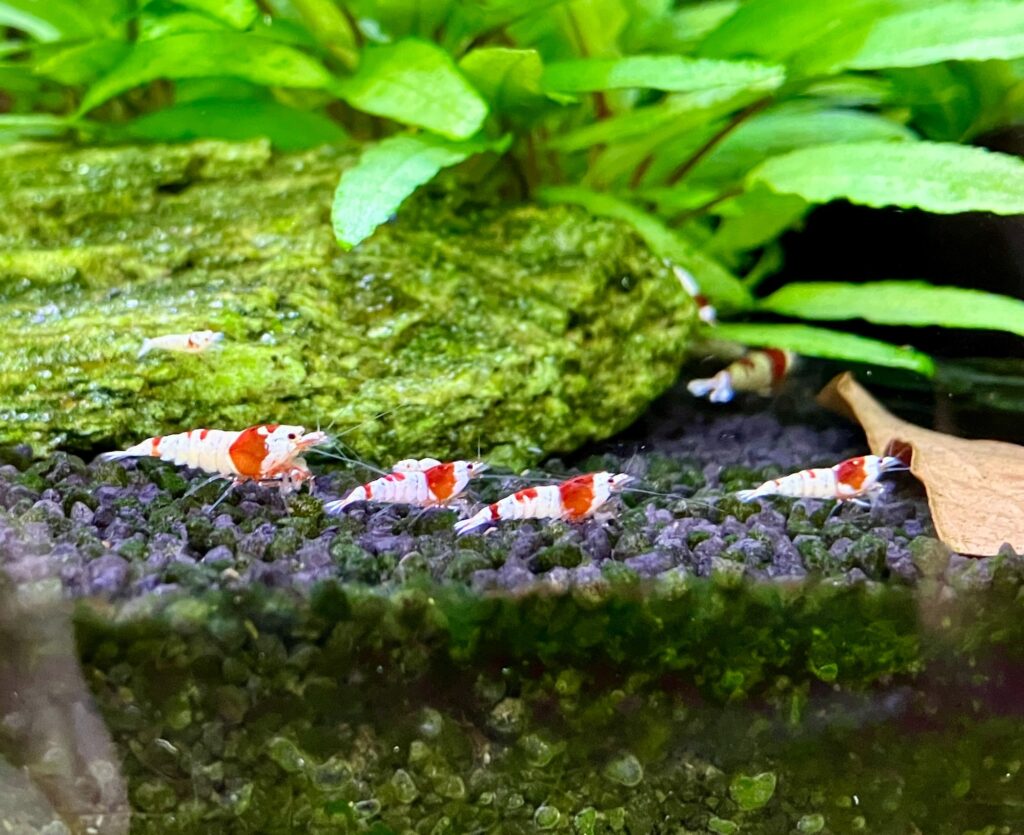
Crystal Red Shrimp (CRS)
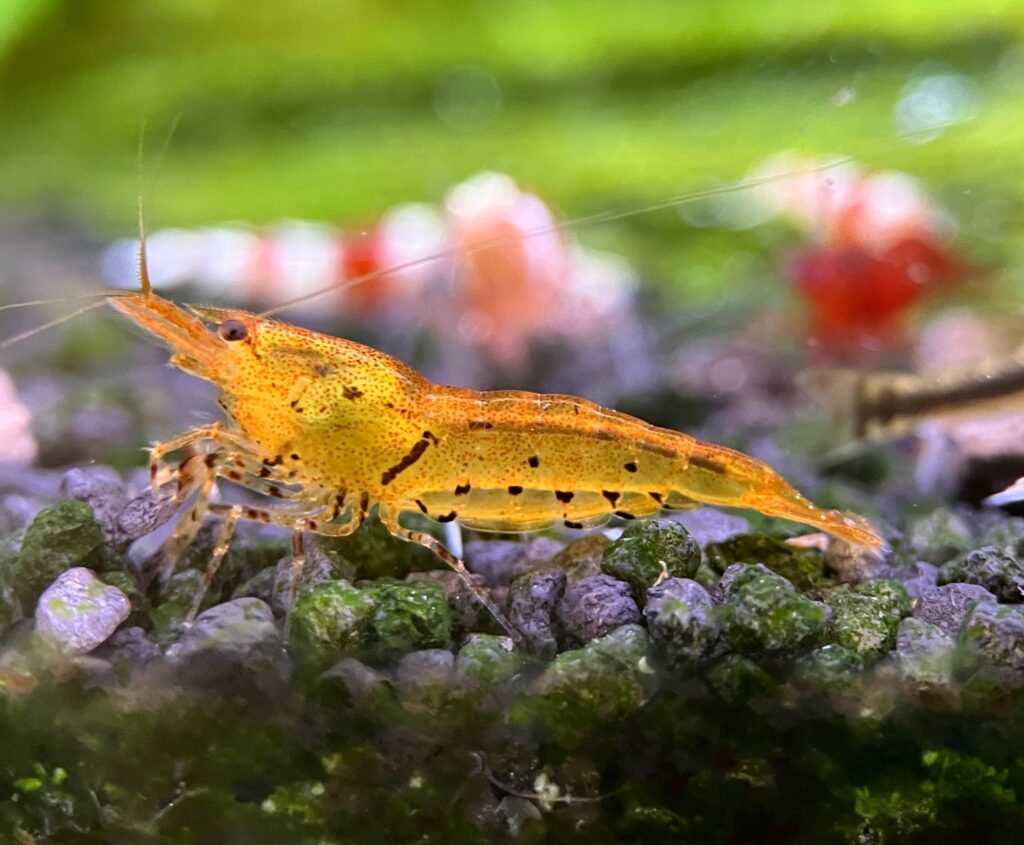
Tangerine Tiger (TT)
Hybrids: Stripes and Spots
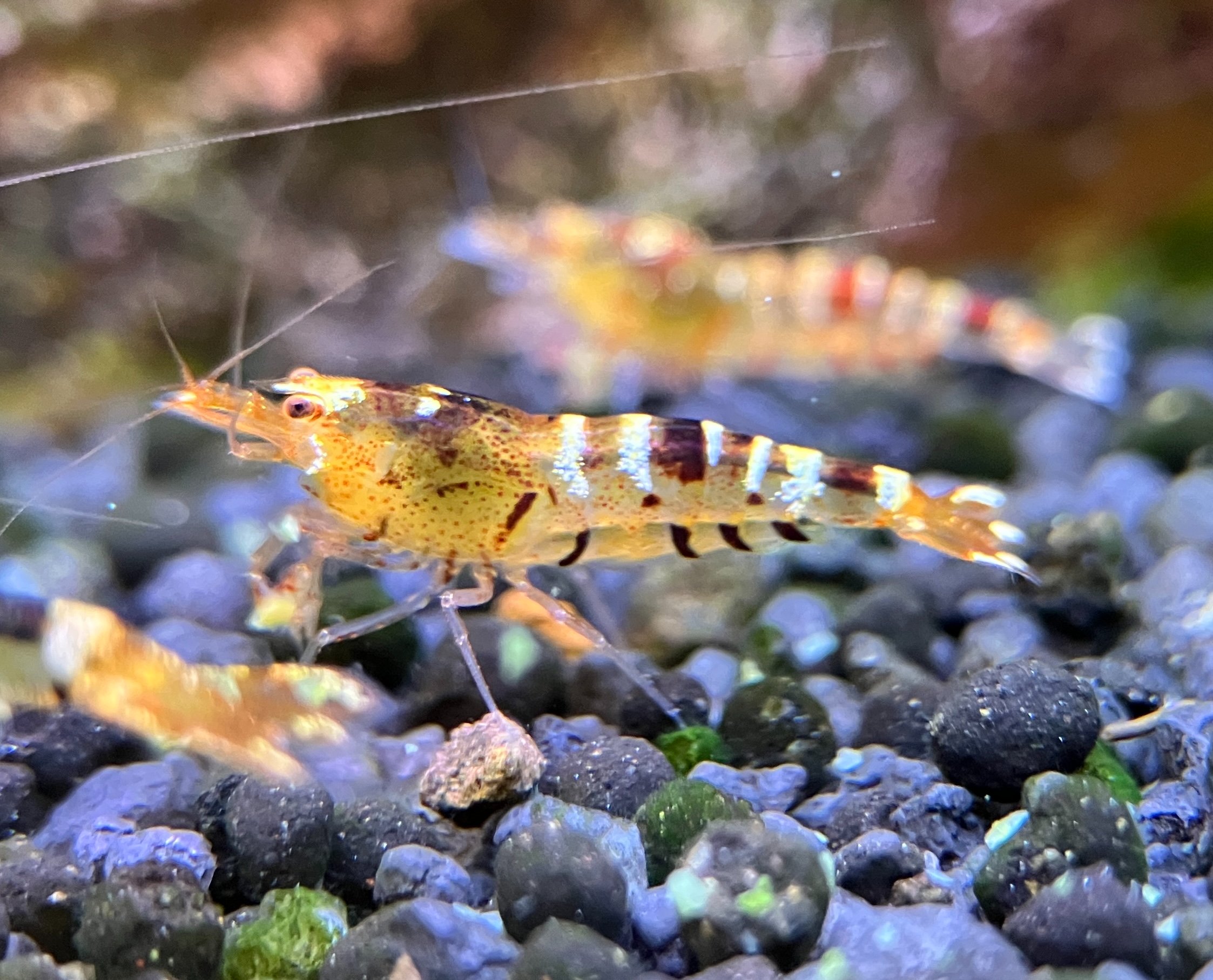
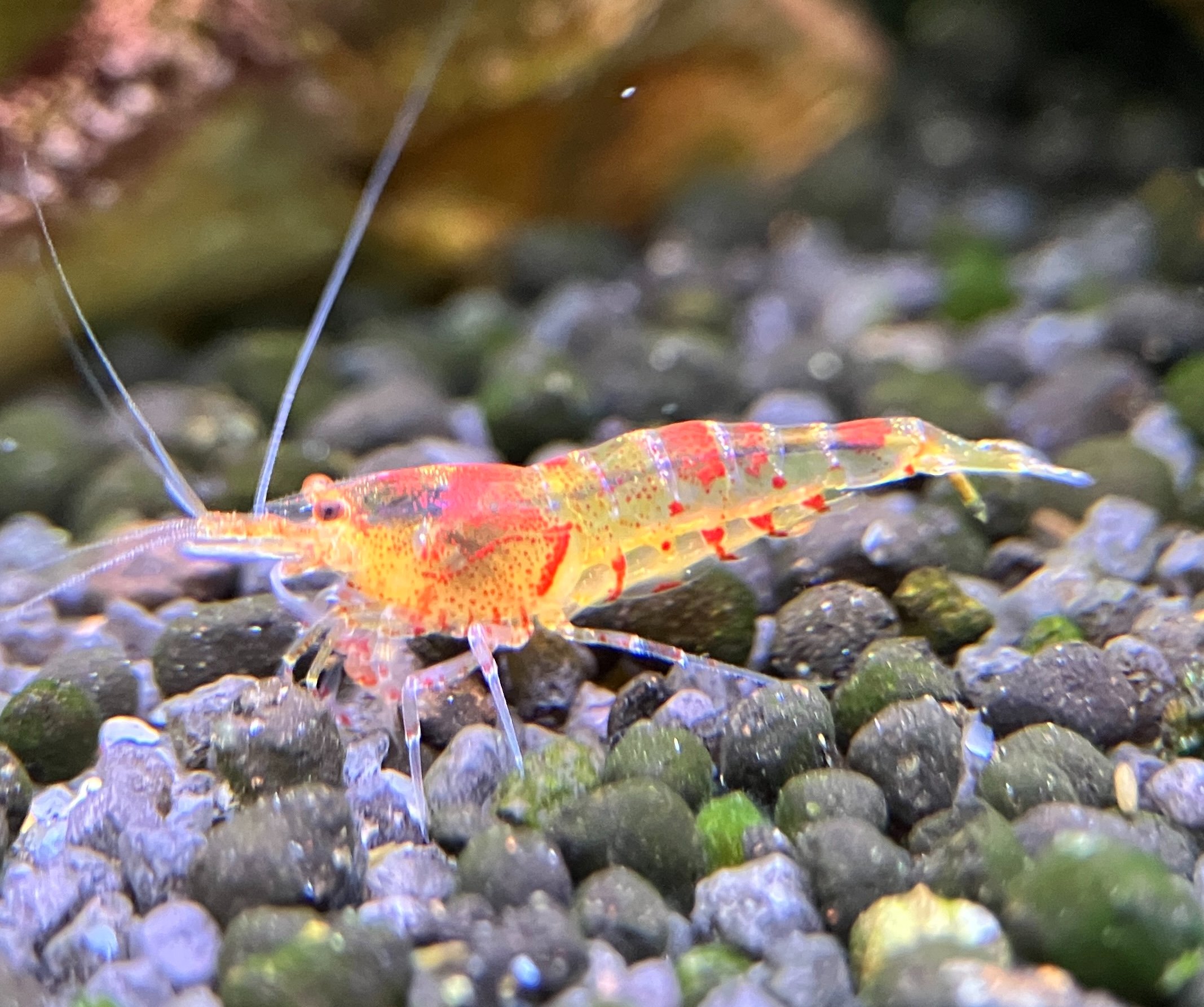
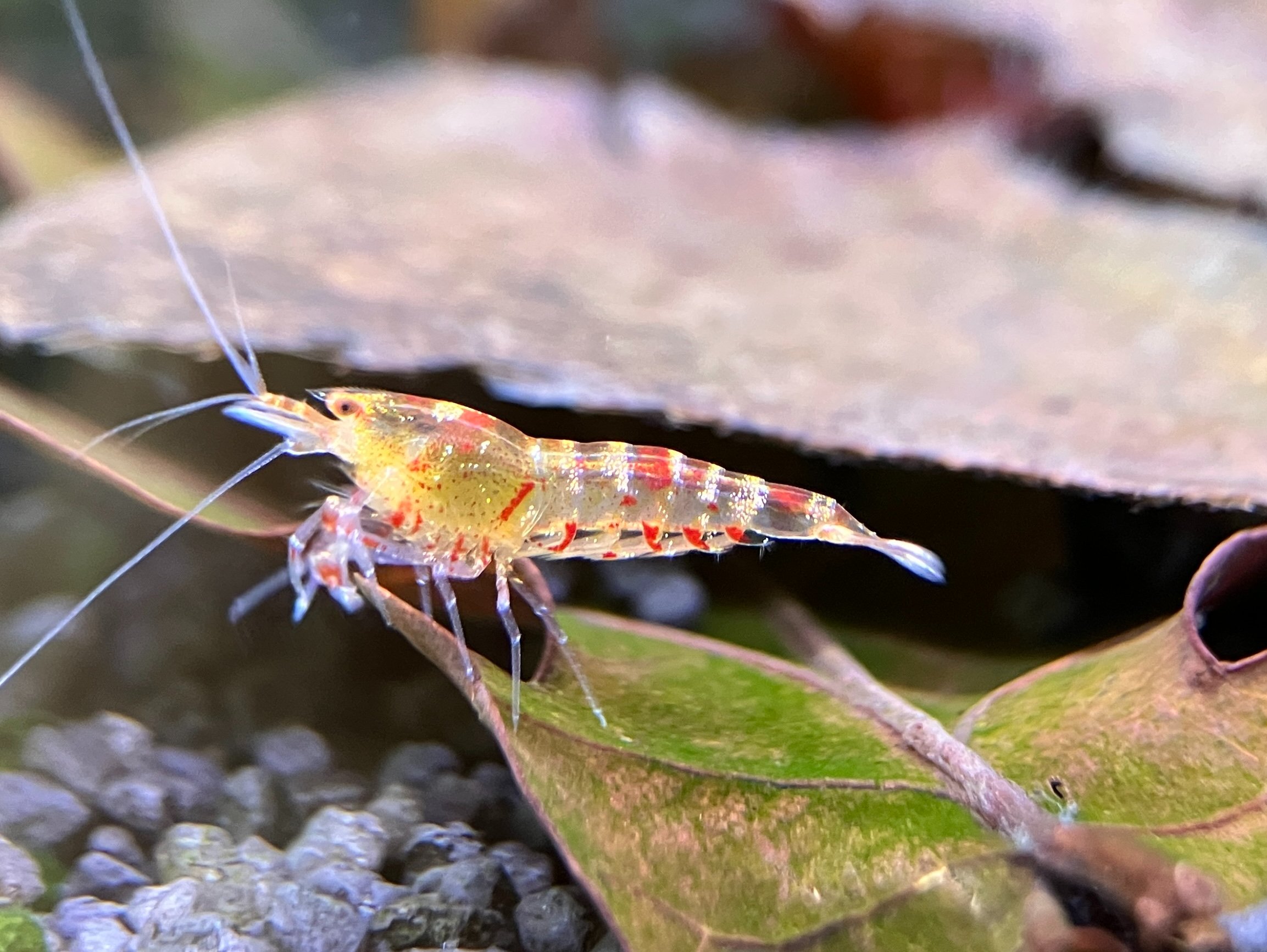
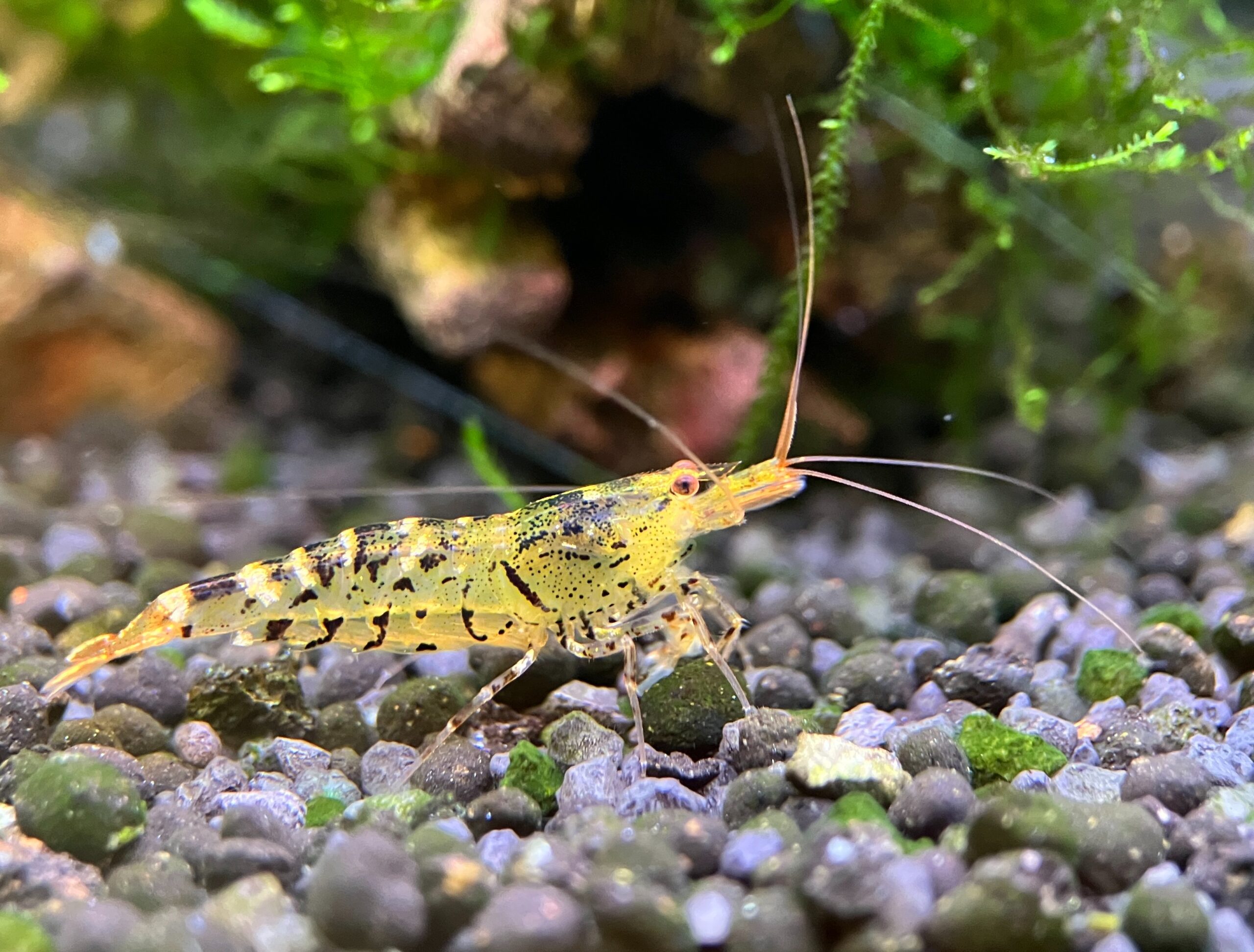
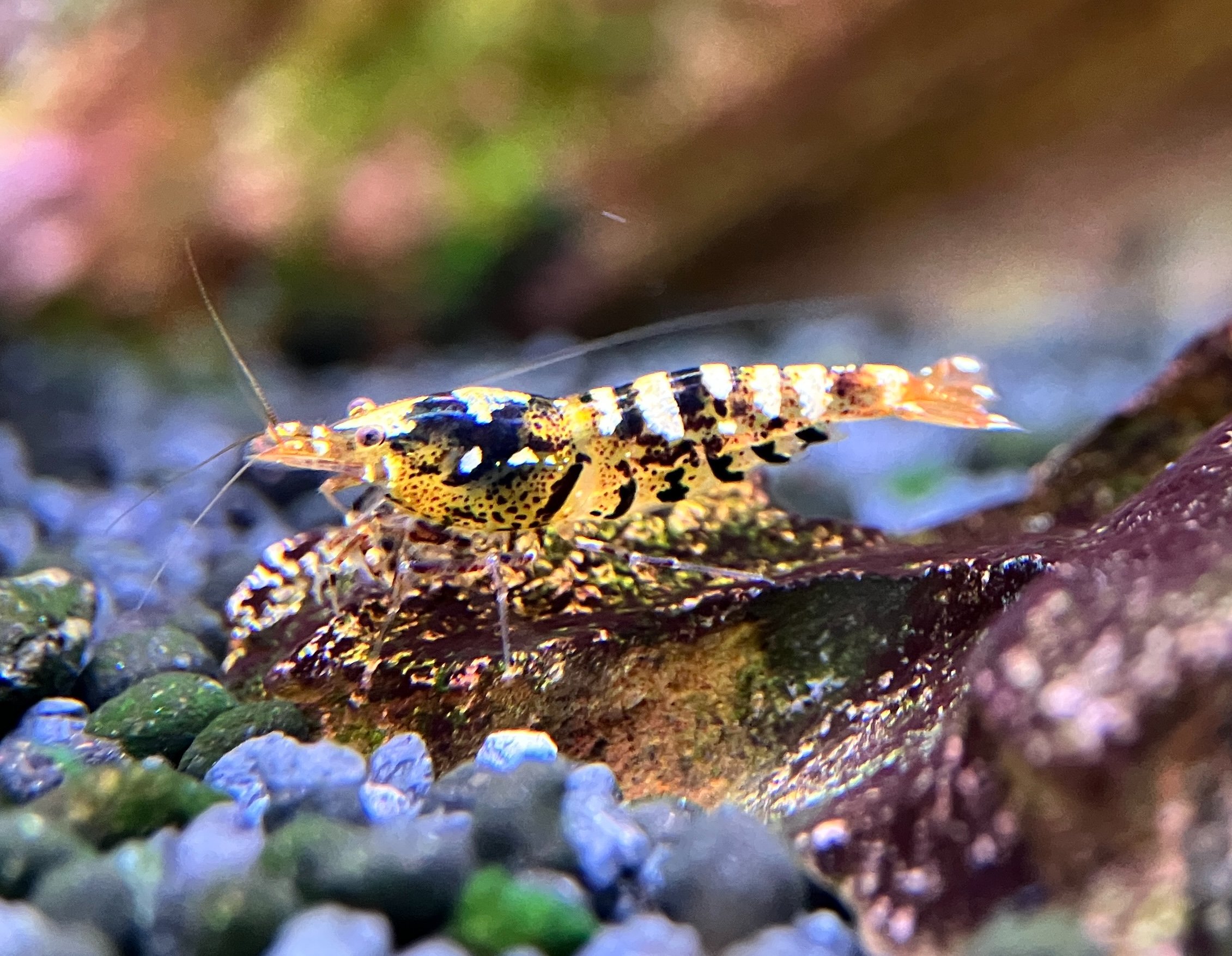
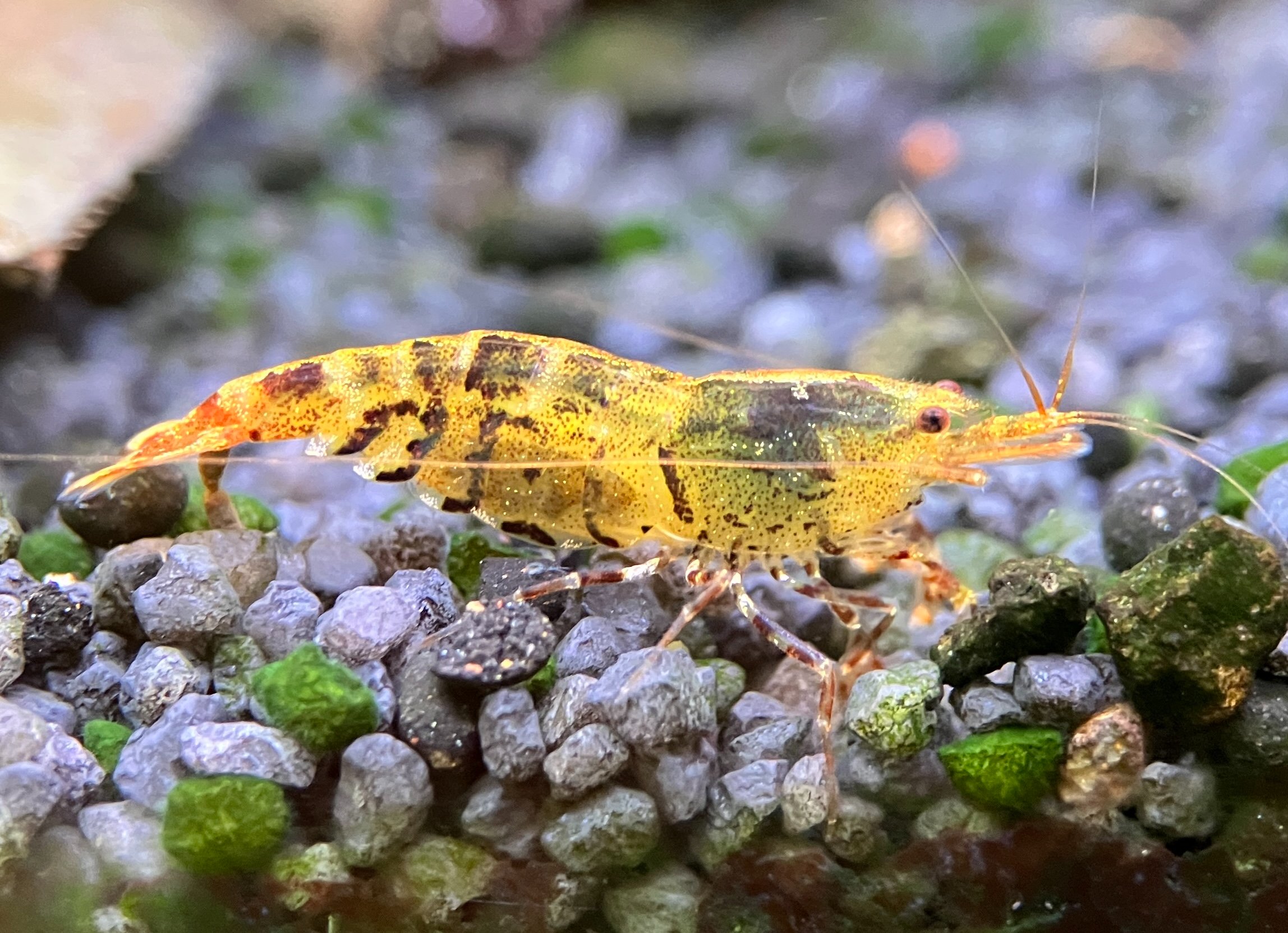
It’s pretty easy to guess from the patterning of the hybrids which pieces came from which parents. I think they all look nice!
Nice Article Andy. I have been struggling to get to grips with the latest taxonomy of this whole group. They interest me, and I breed a few of them, but I find the taxonomy less interesting. However, I am keen to describe them correctly and I am glad you have done some of the hard graft for us !
many thanks, Alan (Hamfist on UKAPS)