
You’ll see a lot of mention/discussion about ‘total dissolved solids’ (TDS) in the hobby. I must say, I’m not a fan and have said so publicly. In the general case the feeling usually goes that ‘high TDS is bad’, particularly for sensitive(?) species like Caridina shrimp. I understand the intent here (mostly) and how that feeling could arise. There is some potential real science here around osmotic stress but in the main I think TDS gets blamed for the actual problems around alkalinity and toxic metals.
Much more background on all that below, but it turns out TDS meters are actually really great electrical conductivity meters. So why might you want a conductivity meter?
Conductivity is a key reference parameter for aqueous reagents
I have been making some very careful measurements of low alkalinity solutions. One of the things I’m always really careful about is making up the various solutions correctly from known stock concentrations. All else being equal, if a key reagent can be purchased from a reagents supplier with legitimate quality control and analytical-grade precision, I’ll go for that.
I use a lot of hydrochloric acid, so that’s an important one. My go-to stock concentration is purchased 1M HCl solution – beefy enough so you don’t need much, but not beefy enough to get into serious health & safety territory. For titrations, I used to use 30 mM HCl (which I made up myself by diluting 1M stock) but figured I’d boost the quality and the precision by using purchased 50 mM HCl for more typical higher alkalinity solutions and 10 mM HCl for low-alkalinity precision work.
Couple of surprises…
Titrations not behaving as expected
I know that using the colourless endpoint of the mixed indicator titration will underestimate the alkalinity of higher alkalinity solutions – really some sort of pinkish endpoint colour would be more accurate. That’s ok. I’m making Shrimphaus water in two stages. First I measure the alkalinity of Cambridgeshire tapwater using 50 mM HCl as a titrant. I then add 1 M HCl sufficient to reduce the alkalinity to (nominal) 20 ppm. In the second stage, I remeasure the lower alkalinity water more accurately using 10 mM HCl titrant where now I’m in the range of alkalinity where colourless is the right endpoint.
So I expected that the nominally 20 ppm water would actually be more like 30 ppm when requantified with the 10 mM HCl titrant, but… it wasn’t. Instead it came out to a measured 20 ppm. On the surface of it one would be tempted to ‘take the win’ but it shouldn’t be behaving that way. Nagging science worry.
Surprise reference lab result
I have also been sending quite a good amount of water samples off to Oceamo for high-tech analysis, mainly with respect to accurately quantifying copper in the parts per billion range, but they measure lots of stuff, including alkalinity. I sent Shrimphaus tank water off and it came back at 1.41 dKH. Say what…?!? I had been aiming for 10 ppm CaCO3 equivalents in the water change water, with the idea that after all is said and done biologically in the tank that might be somewhere between 15-20 ppm, but 1.41 dKH is 25 ppm. Where did all the extra alkalinity come from?
My first thought (wrong!) was to blame Oceamo. Maybe they are doing the standard titration to a pH endpoint of 4.6 which would give an alkalinity over-estimate. Yes, but not by this much of a difference. In any event, this is what they do, all day, every day. They’re going to be good at it.
Defined alkalinity result also wrong
I made up a defined stock solution using reagent grade NaHCO3 and highly purified water and did the usual titrations vs. a known starting alkalinity. Here’s where it got weird. Doing the titration with 50 mM HCl gave the expected result based on the known bicarbonate starting concentration, but doing the titration with the 10 mM HCl gave an alkalinity read about 25% lower than it should have been. So how could that be? The only difference was using 10 mM vs. 50 mM HCl for the titration. But what if the 10 mM HCl is not 10 mM as advertised? If the 10 mM HCl were actually 13.5 mM, that would account for the observed results. How could you tell?
Measuring conductivity invalidated a label claim for a key HCl reagent
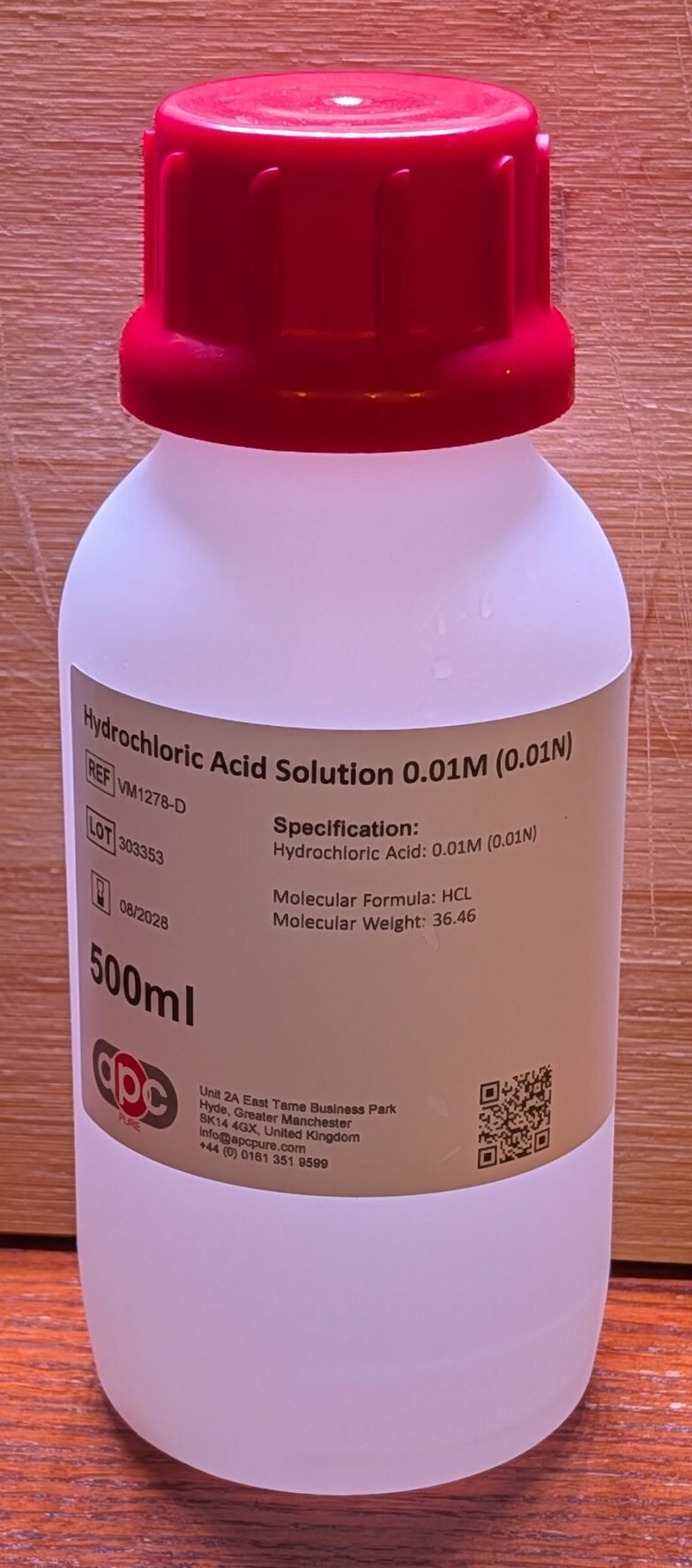
Let’s come at this a completely different way. In an HCl solution other than water, there is only H+ and Cl-, and both can conduct electricity. Dilute HCl has been extraordinarily well characterised with respect to conductivity and long story short, a 1 mM HCl solution should come in at around 425 μS/cm. So I have 3 independent HCl stock bottles, 10 mM, 50 mM and 1 M. Let’s dilute them each to 1 mM and measure the electrical conductivity – using the “TDS meter”, naturally.
1 M HCl stock diluted to 1 mM → conductivity 424 µS/cm
50 mM HCl stock diluted to 1 mM → conductivity 428 µS/cm
10 mM HCl stock diluted to 1 mM → conductivity 578 µS/cm (!)
Well there you go. For HCl the conductivity is directly proportional to the acid concentration, so the 10 mM stock bottle is actually more like 578/428 = 13.5 mM, exactly as indicated by the titration against a defined alkalinity reference. When you work it through, the incorrectly labelled 10 mM HCl bottle also neatly accounts for the anomalous first stage titration result and the discrepancy with the Oceamo lab.
Not very satisfying vendor response
So of course I call up the vendor (no name and shame but you could look at the enclosed picture). First I request the spec sheet, which they provide. It says 0.0098–0.0102 M, lot 303353, with an expiry date of 08/2028. So my bottle is not even vaguely in spec. I explain both the reference solution titrations and share the conductivity data with them. I repeatedly offer to send the bottle back to them for testing. Instead, they go and re-measure the bulk material (not the actual end-user packed material) at 0.0096 M which is out of their own spec, but low rather than high. They decided that instead of investigating further and fixing the problem they would instead “widen their spec” to 0.0095–0.0105 M. They asked if I wanted a refund and I don’t really care, it’s £12 worth of stuff, I mostly want the discrepancies with respect to the label sorted, but I say ok sure and again offer to send my bottle back to them for testing and to order a fresh bottle of 10 mM HCl from them. They tell me if I reorder it I’ll just get the same lot that I got last time (so probably just the same problem all over again) so don’t do that. They’ll refund my money (which they did) and they will not allow me to order the same product again. Ok wow. Just wow.
Still, fantastically great use case for a TDS meter! Who knew?
<rant>
TDS meters actually measure conductivity
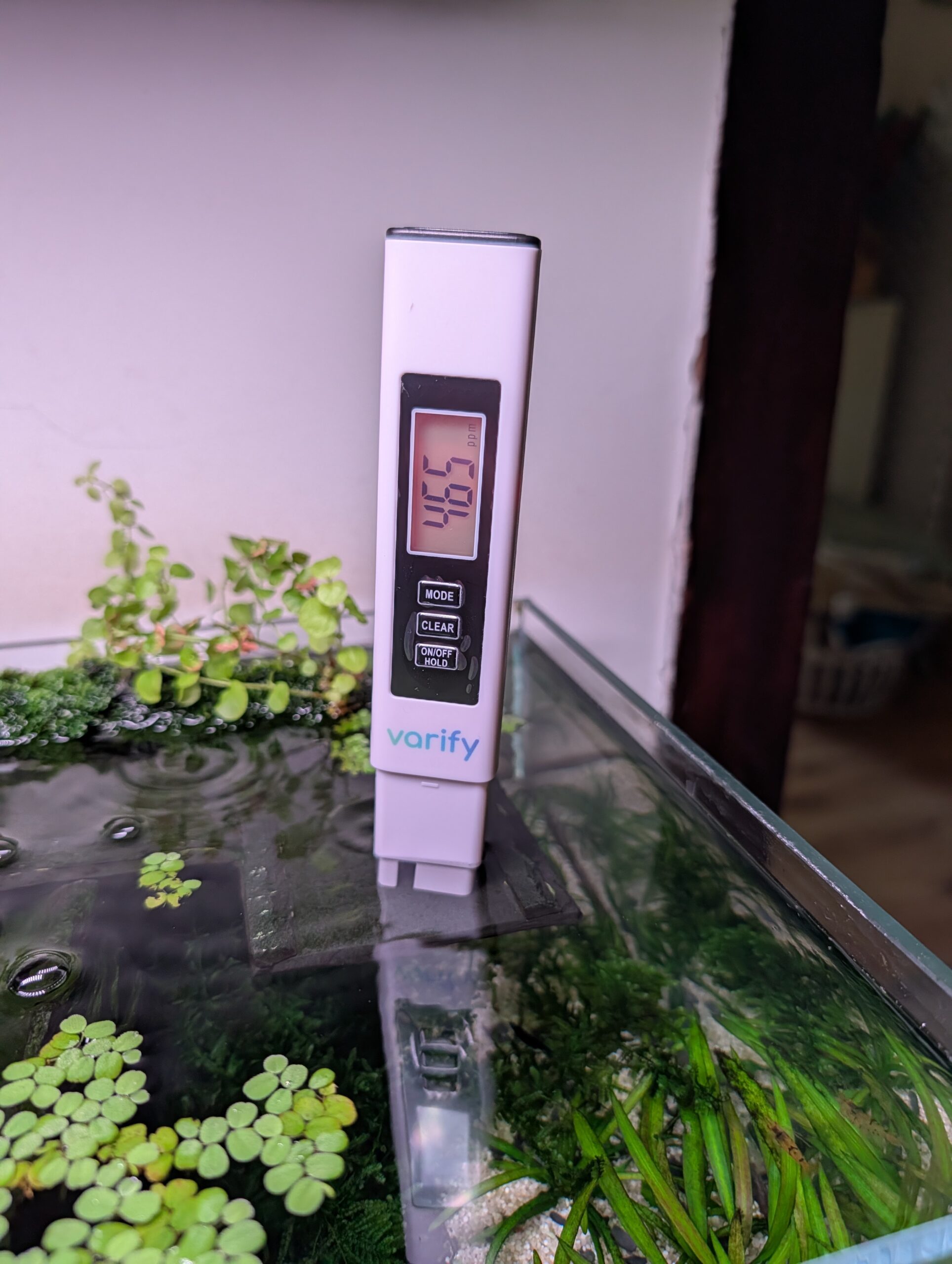
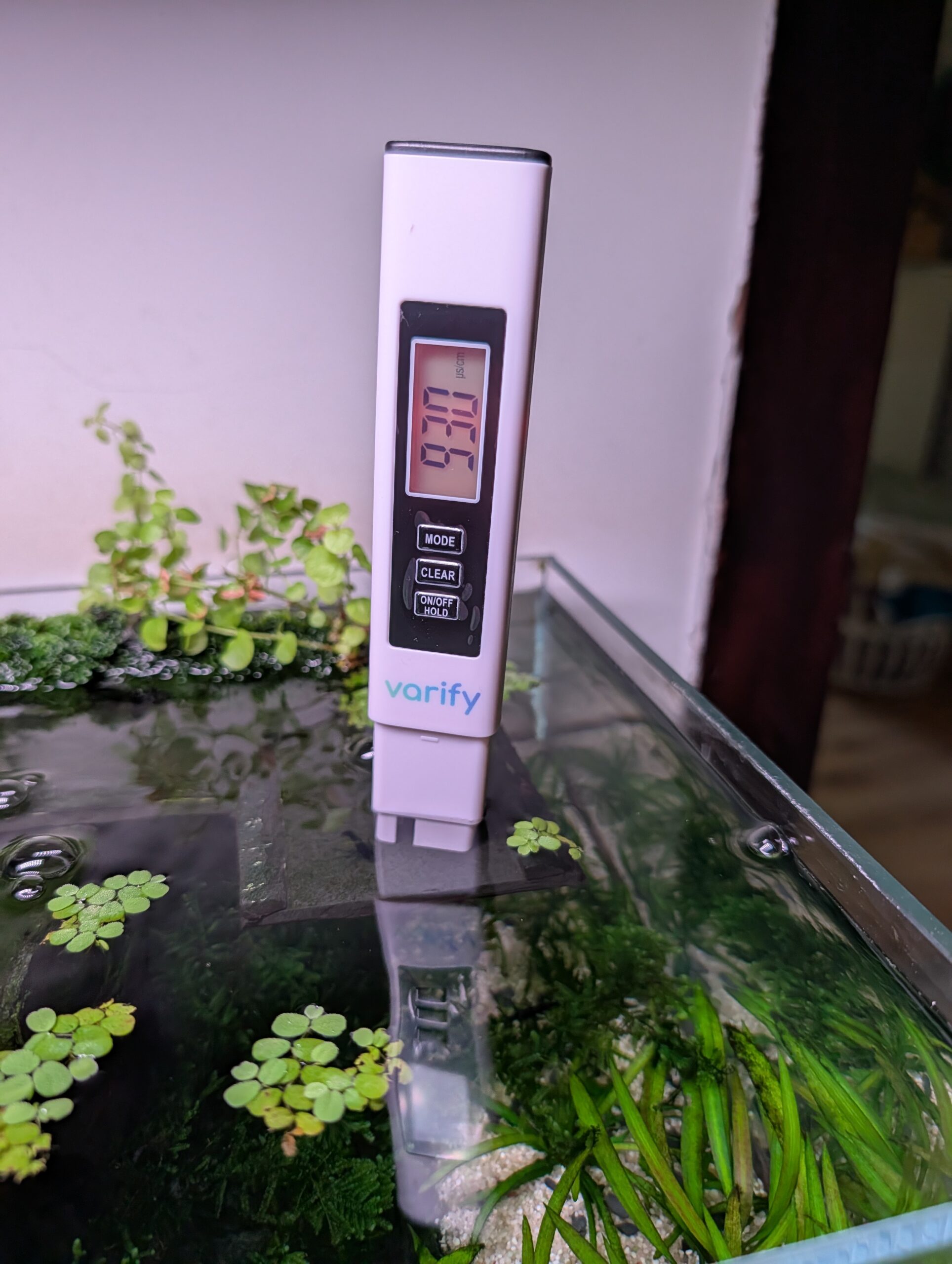
In the hobby mostly when people think they are measuring TDS, the reality is they are actually measuring electrical conductivity, for example by using an inexpensive “4-in-1 TDS Meter Digital Water Tester“. Measuring electrical conductivity is pretty easy to do reasonably well and gives you a read on ‘how much charged stuff’ is in the water. If you make some (mostly) reasonable assumptions about what the typical charge carriers are going to be in an aquarium and look the other way when someone inconveniently points out that TDS actually should include both charged and uncharged species, you can come up with a conversion factor to go from your actually measured conductivity value to an inferred TDS value. A conversion in which TDS in ppm is taken as half of the conductivity value in μS/cm is pretty typical, so for example, water with measured conductivity of 930 μS/cm would be reported as 465 ppm TDS.
What you actually care about biologically is osmolarity
In terms of fluid behaviour across membrane surfaces, what actually matters is the concentration of dissolved “particles” (in the molecular sense) of any type per unit of water (usually measured in mOsm/L ≃ mOsm/kg). Osmolarity is even harder to directly measure than TDS, but similar to TDS, you can infer a pretty reasonably conversion factor, particularly if you know what the water chemistry looks like. For a typical aquarium where most of the particles will be derived from Ca(HCO3)2, you can take the conductivity reading in μS/cm and multiply by 0.015 to get mOsm/L. In the Shrimphaus, where the HCO3– has been largely replaced with Cl–, multiplying conductivity by 0.0125 is more appropriate.
So, in the picture above where the Shrimphaus came in at 930 μS/cm conductivity, that works out to about 12 mOsm/L.
Safe osmolarity levels for freshwater shrimp
Unfortunately, here is where we run out of good data. One potentially interesting study did a pretty good investigation using Caridina nilotica, which unfortunately isn’t very genetically close to C. logemanni or C. cantonensis, but they showed a ‘no effect observed concentration’ (NOEC) of over 40 mOsm/L which would be around a conductivity north of 2600 μS/cm or a typical TDS read of 1300 ppm. For what that’s worth.
Slaughter AR, Palmer CG, Muller WJ. (2008). A chronic toxicity test protocol using Caridina nilotica (Decapoda: Atyidae) and the generation of salinity toxicity data. African Journal of Aquatic Science 33(1): 37–44. DOI: 10.2989/AJAS.2007.33.1.4.388