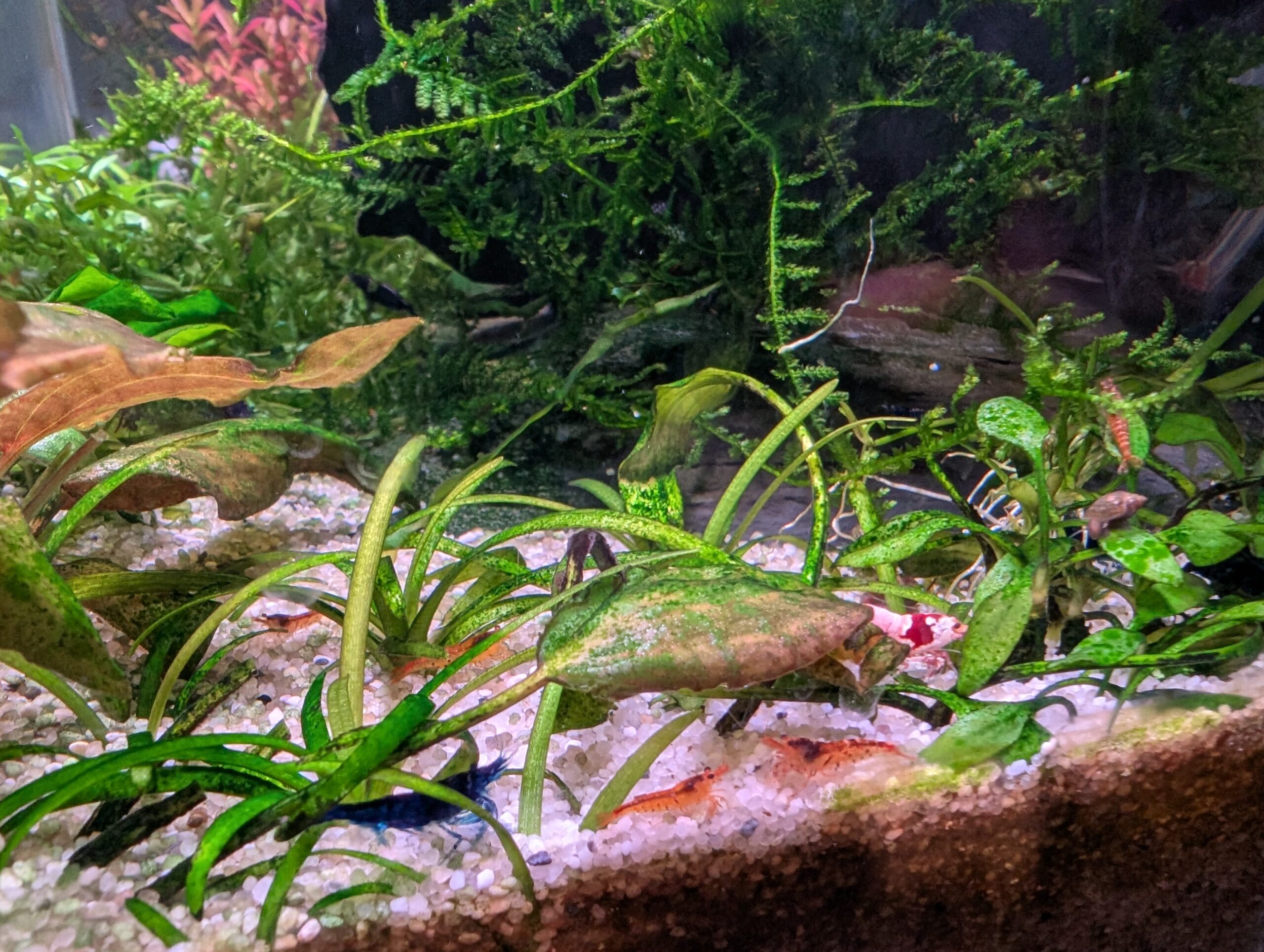
I love my shrimp! It’s great fun watching them zoom happily around the Shrimphaus. The conventional wisdom in the hobby is keep different fancy colour morphs of the same species separate, so they don’t cross-breed and revert to “boring” wild-type colouration, but it is fun to experiment as well and if you’re not too fussed you can buy a “skittles mix” with a little of everything and see what happens. Shrimphaus is currently living that in an inter-species way. We have blue velvets (Neocaridina davidi), pure red line (PRL) crystal reds (Caridina logemanni) and now tangerine tigers (Caridina serrata Caridina cantonensis) in the same environment. But how to sort out what will and won’t (or probably won’t) crossbreed successfully? It is commonly understood that neocaridina will not crossbreed with caridina (and that’s true – more on this later), but what about within those two groups, for example between the PRLs and the tangerine tigers? What does it even mean to be a species? Let’s dive in, because science!
Freshwater shrimp genetics
1. What is a species?
Let’s sort things out genetically. The idea is simple: the longer two ‘species’ live separated from each other, the more their DNA sequences will drift apart due to random mutation over time. We can take one reference gene, sequence that gene in different species, and count how many genetic changes there are from one to the other. This turns out to be a pretty good clock. A ‘genetic distance’ of 0.1 means on average there are 0.1 changes per position in the gene between species, which works out to around 3.7 million years of living separately. That’s how long two populations would need to live apart to accumulate that level of genetic change.
Thing is, once two species have diverged genetically more than a certain amount, successful interbreeding becomes less likely and eventually impossible altogether. At genetic distances <0.05, ‘species’ are so highly compatible as to not really be different species at all – domestic cats and wildcats are like this. At distances between 0.05 and 0.15, interbreeding is still generally pretty successful. Things get dodgy at genetic distances between 0.15 and 0.25 – crosses, when successful, are often themselves infertile, particularly males (Haldane’s rule). This is what most people would call ‘separate species’: lions and tigers (ligers/tigons), or horses and donkeys (mules). At genetic distances >0.25 there’s essentially no chance of interbreeding at all, like trying to cross a lion with a house cat.
2. Freshwater shrimp genetic distances
Let’s check out the genetic distances between different ‘species’ of freshwater shrimp.
This picture, a small subset of the overall Tree of Life, shows genetic similarities and differences between 17 different freshwater shrimp species commonly available in the aquarium trade. Species represent leaves on the tree. The lengths of the black branches on the tree are proportional to genetic distance – the longer a branch is, the more diverged (less similar) the species in question is. Branches radiating from a central point illustrate species that diverged from a historical common ancestor. Remember though, we’re talking evolutionary time divergence here, measured in millions of years, not the selective breeding happening in the aquarium industry today. To determine the genetic distance between two species, start at a “leaf” on the tree representing one species and walk along the branches, taking the shortest route to the leaf representing the other species. The total length you travelled along all the branches is the genetic distance between the two species.
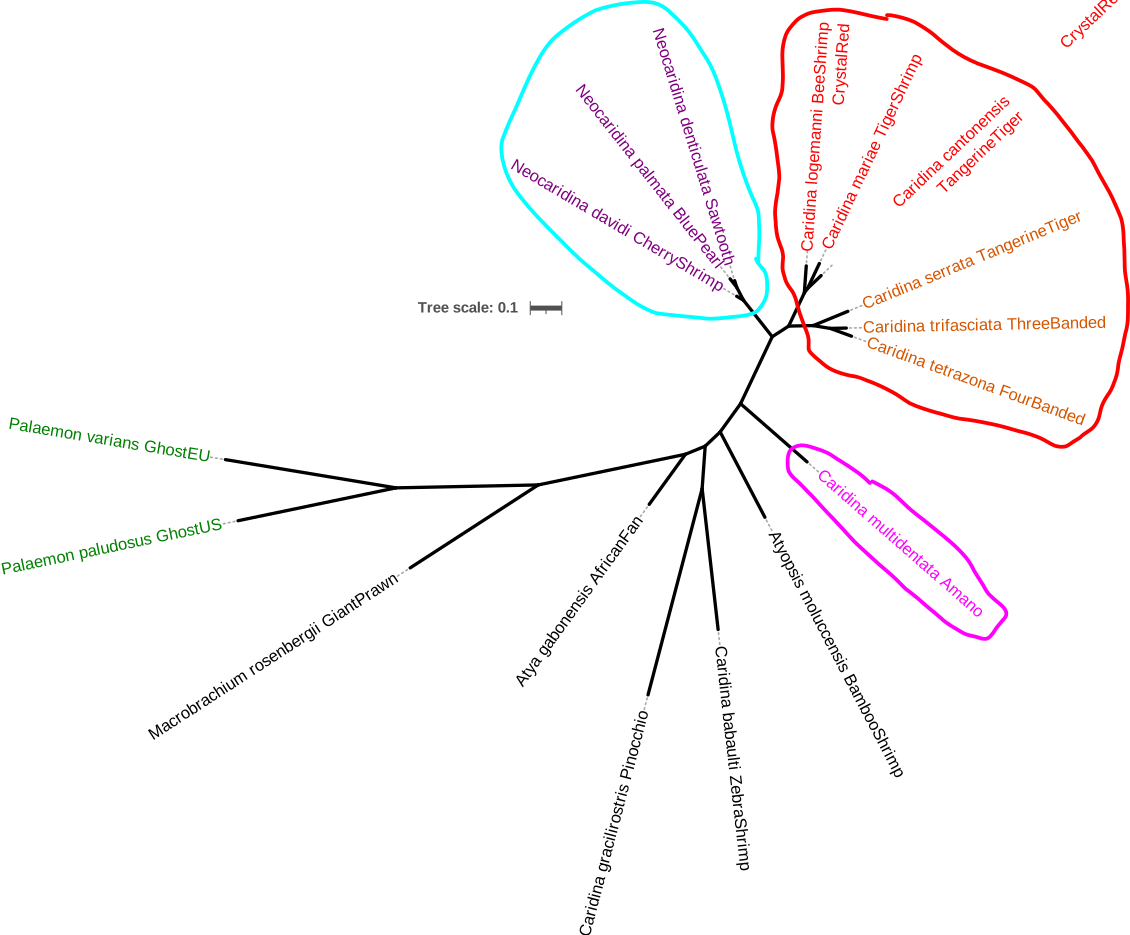
Technically, the picture is an “unrooted phylogram”. It was created in a scientifically rigorous manner, but it does not necessarily represent a “professional scientific literature” depth of analysis. Plenty good enough for our purposes though.
Neocaridina species: cherry shrimp
One thing that is super obvious looking at the tree is the three neocaridina species N. davidi (everyone’s favourite cherry shrimp), N. palmata and N. denticulata group together (cyan circle) as tightly clustered leaves on one branch. The biggest distance (along the branches) between these leaves is about 0.1 so interbreeding different neocaridina species with each other is going to be pretty successful.
‘Main’ caridina species
Caridina are a bit more of a mess and for more than one reason. The hobby gets a lot of these common names wrong. Tangerine Tigers are almost universally called C. serrata but actually they are C. cantonenesis. Crystal Reds get called C. cantonensis but actually they are C. logemanni.
Taking the corrected names as read for now, there are two groups of three species coming off one main branch (red circle).
Crystal red shrimp, bee shrimp, tiger shrimp, tangerine tiger shrimp
Crystal reds (C. logemanni – another fan favourite), bee shrimp (a different colour morph of C. logemanni), tiger shrimp (C. mariae) and tangerine tiger shrimp (C. cantonensis) are in one group (crystal red group – red labels). Genetic distances within this group range from 0.15 to 0.19. That’s not too bad and indeed there are well-document crosses possible – see the discussion of ‘Tibees’ below.
Serrata, three-banded shrimp, four-banded shrimp
C. serrata (widely but incorrectly used in the hobby as the species name for Tangerine Tigers), three-banded (C. trifasciata) and four-banded (C. tetrazona) shrimp are the other (serrata group – orange labels). The three-banded and four-banded shrimp are actually pretty close, at around 0.12 units, so should be able to mix it up pretty well, but they’re both around 0.23 to 0.25 from C. serrata which would be much more challenging – probably not possible.
Crosses between the two caridina subgroups won’t happen
This just isn’t going to work. Genetic distances range from 0.38 to 0.43 which is well into the impossible zone. Interestingly, the genetic distance between the two caridina subgroups is about the same as the genetic distance between any of the caridina and neocaridina species. Just because two species share the ‘caridina‘ name doesn’t mean they are genetically close to each other.
Caridina outliers: Amano shrimp
Amano shrimp (C. multidentata – super algae eaters), zebra shrimp (C. babaulti) and Pinocchio shrimp (C. gracilirostris) are just miles apart (genetically) from both each other and all other freshwater shrimp species. No chance any of these will ever interbreed with anything. These guys are so separated from the main caridina species (again genetically) that it’s not really credible to call them ‘caridina’ at all… that’s some early taxonomy based on morphology (shape, size and body part configuration) getting it wrong.
Mixing different species – go or no go?
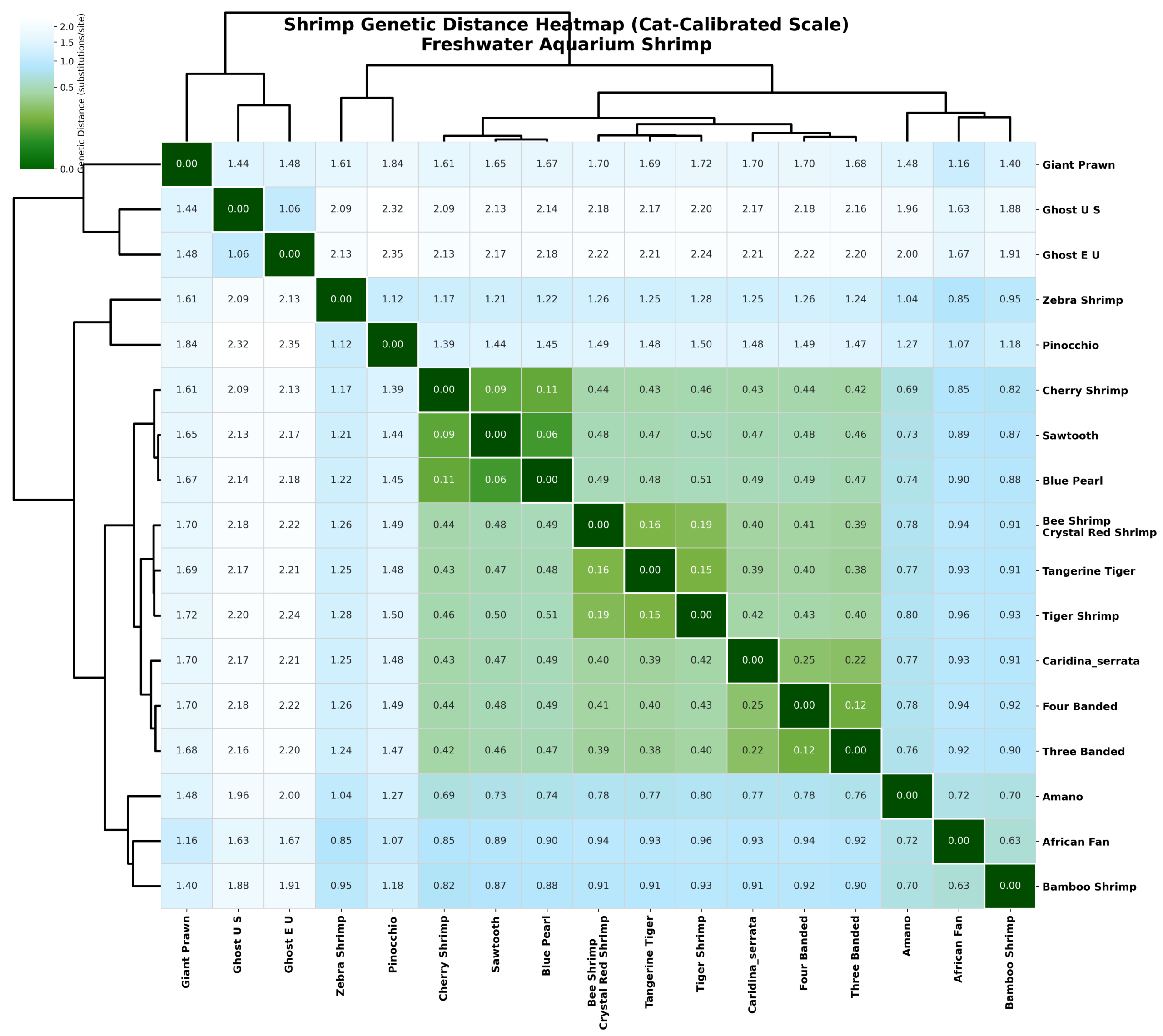
Here is a heatmap that covers all possible combinations of 17 different freshwater shrimp species, listing genetic distance and colour coded for similarity. Dark green is a distance of 0 showing that individual species are capable of reproducing with themselves. After that the viability of crosses falls off really fast. The ‘dendrograms’ on the top and left side of the heatmap are the rectangular versions of the phylogram we saw above.
Shrimphaus species: blue velvet, crystal red and tangerine tiger
It’s maybe not a surprise that the blue velvet neocaridinas at a genetic distance of 0.43 can’t cross with either of the caridina species. But the two caridina species: C. logemanni (CRS) and C. cantonensis (Tangerine Tiger), at a distance of 0.16 will be able to produce hybrids (so far they haven’t, but still early days).
Ghostly separation
The ghost shrimp come in American (Palaemon paludosus) and European (Palaemon varians) flavours: a nice example of convergent evolution. Even though they look nearly identical and both get used as feeder shrimp (!), at a genetic distance of 1.06 they are separated by about 40 million years of evolution and the width of the Atlantic Ocean. They are completely isolated genetically from each other.
Crystal reds and red cherries
Maybe the paradigm of caridina vs. neocaridina. No inter-species mating possible.
Crosses that work: Tibees
“Tibees” are either Crystal Reds or Taiwan Bees (both C. logemanni) crossed with Tiger Shrimp (C. mariae). At a genetic distance of 0.19, this mix is right at the edge of what’s possible to pull off successfully. The first-generation Tibees (F1) aren’t very attractive, with muddled patterns and mixed colours. But then it gets interesting: breeders back-cross the F1 Tibees to the original parental types (either crystal reds or tigers), and after a few rounds of selection get some fancy varieties like “Pintos” and “Taitibees” with novel colour combinations and patterns that wouldn’t exist in either parent species alone. This process is called introgressive breeding – using the F1 hybrid as a genetic bridge to move interesting traits between species, then cleaning up the mess by breeding back to the clean parental lines. It’s easier once you have the F1 because the genetic distance back to the parents is only half as large.
Cat calibrators
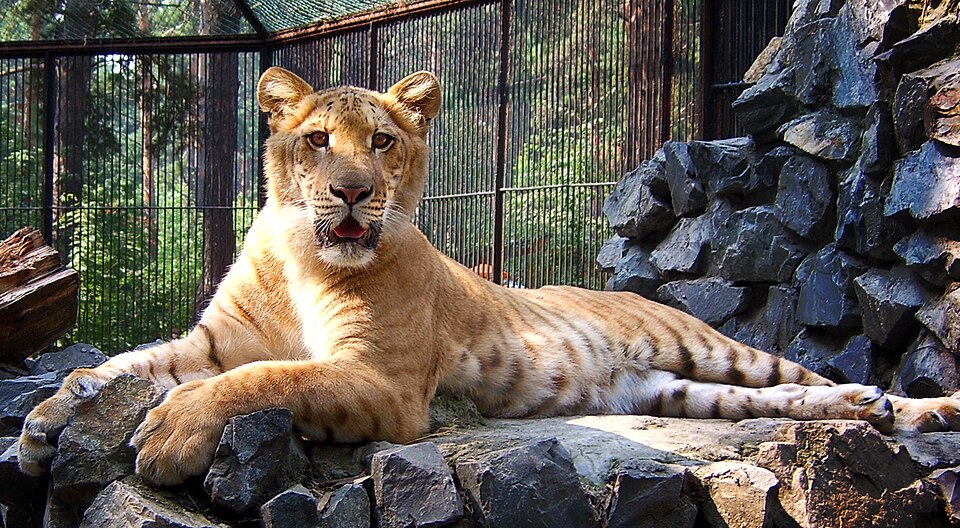

In case you were wondering how the scale of genetic distances with respect to fertility was calibrated here, it all comes from cats! The different cat species are very well characterised genetically, and the viability and fertility of various crosses is also well understood. Interestingly, the molecular mechanism determining hybrid fertility (successful parental chromosomal synapsis and disjunction in Meiosis I) is near-universal in sexually reproducing species and only cares about the degree of genetic identity (genetic distance) between homologous chromosomes. That’s a fancy way of saying what works for cats will work for shrimp.
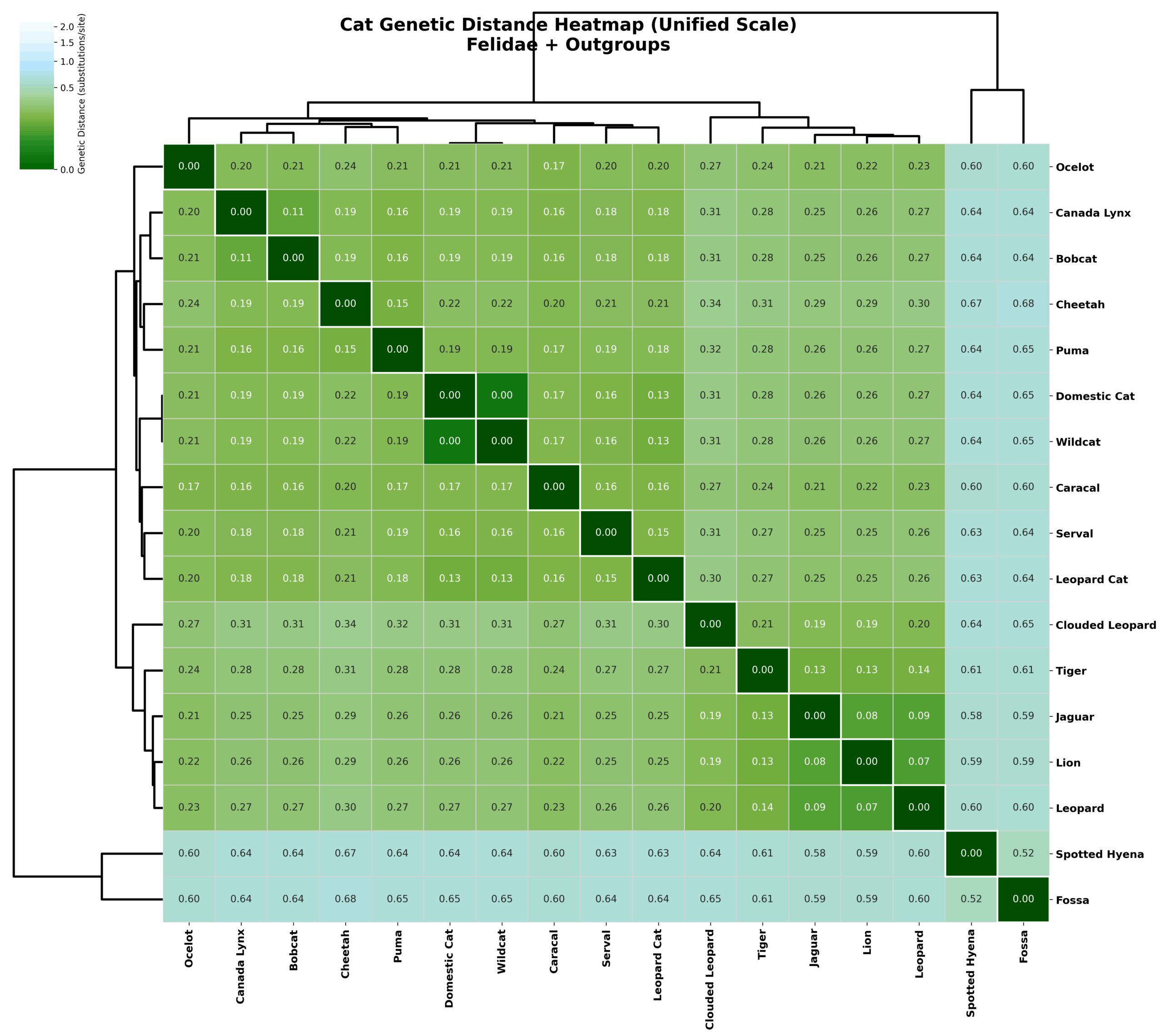
The various cats are, in general, much more highly related to other than the shrimp are to other shrimp. This heatmap uses the same colour scale as the shrimp heatmap and shows a lot more green and darker green generally. The common housecat and the wildcat are essentially the same species, with a relative genetic distance of 0.00. Jaguars, lions and leopards are all pretty close to each other as well with tigers just a little further off.
People who want to know more about the various cat crosses can check some of these out:
- Phylogenomic evidence for ancient hybridization in the genomes of living cats (Felidae) – pretty heavy going, but definitive
- Domestic x Wildcat Hybrids – pretty cool summary, very accessible